
• ECommerce Search Engine Optimization: The 2026 Guide to Inclusive Growth

    ECommerce Search Engine Optimization: The 2026 Guide to Inclusive Growth

    Did you know that 77% of all website accessibility lawsuits now specifically target eCommerce businesses? For many stakeholders, the persistent threat of an ADA demand letter is just as taxing as the struggle to reverse stagnant organic traffic. You likely recognize that your digital presence must be both highly visible and legally sound, yet the technical complexity of WCAG 2.2 standards often feels like a barrier to the very growth you’re trying to achieve.

    This guide provides a strategic roadmap for eCommerce search engine optimization in an era where inclusive search efficiency is the new benchmark for success. We’ll show you how to align your store with modern accessibility standards to shield your brand from litigation while simultaneously capturing 100% of your potential market. You will learn how to navigate the March and May 2026 Google Core Updates by implementing professional remediation that turns regulatory compliance into a powerful engine for sustainable, top-tier rankings. By the end of this article, you’ll understand how to transform technical requirements into a protective foundation for your brand’s future.

    Key Takeaways

    • Understand why modern eCommerce search engine optimization requires a shift from simple keyword targeting to a holistic model of inclusive search efficiency that prioritizes user intent and technical compliance.
    • Discover how aligning your technical SEO with WCAG 2.2 standards creates a synergistic effect that improves Core Web Vitals and ensures your site is indexable for both search bots and assistive devices.
    • Learn the critical distinctions between B2B and B2C search intent to ensure your content strategy addresses the specific informational needs of organizational stakeholders versus individual consumers.
    • Implement a remediation-first growth strategy that identifies and corrects accessibility barriers before scaling traffic, protecting your brand from legal liability while securing long-term rankings.
    • Explore how ongoing monitoring tools like a11y.Radar can maintain your competitive edge by preventing new accessibility issues from compromising your SEO gains and site performance.

    Table of Contents

    • The Evolution of eCommerce Search Engine Optimization in 2026
    • Building a Foundation: Technical SEO and Accessibility Synergy
    • Strategic Comparison: B2B vs. B2C eCommerce SEO Models
    • Execution: A Remediation-Led Strategy for Sustainable Growth
    • The 216digital Advantage: Protecting and Growing Your Storefront

    The Evolution of eCommerce Search Engine Optimization in 2026

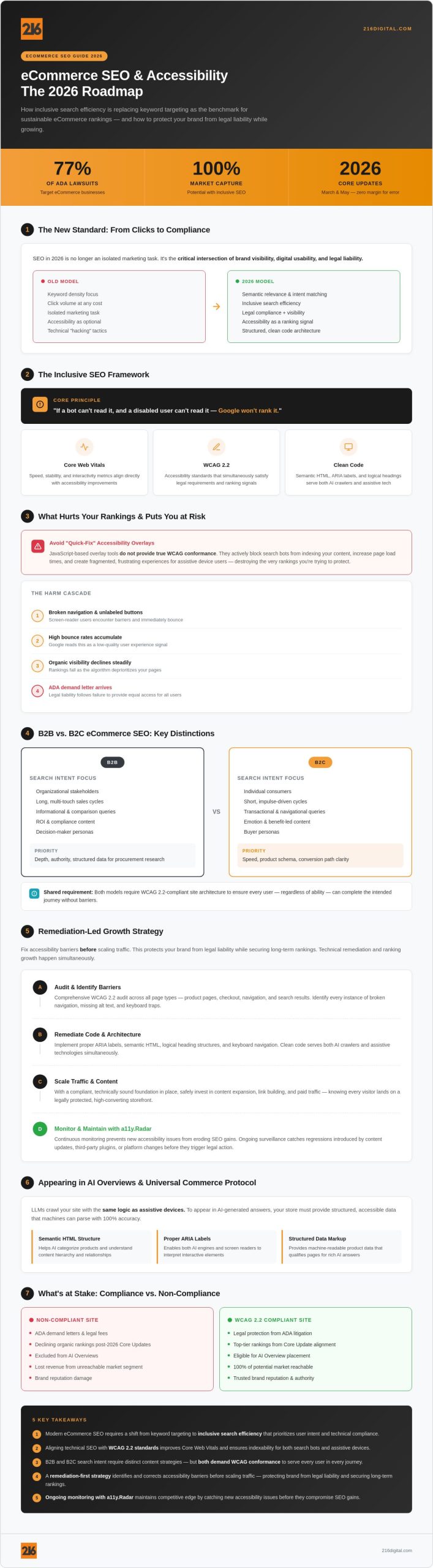
    In 2026, search engine optimization (SEO) is no longer an isolated marketing task. It’s the critical intersection of brand visibility, digital usability, and legal liability. Traditional methods that relied on keyword density have been replaced by sophisticated semantic relevance and intent matching. Search engines now prioritize how well a store serves its entire audience, including those using assistive technologies. If your content doesn’t align with the specific intent of a query, no amount of technical “hacking” will secure a top position.

    As a business owner, you must adopt the role of the Authoritative Protector. This means your eCommerce search engine optimization strategy isn’t just about chasing traffic; it’s about guarding your brand against the rising tide of ADA demand letters and regulatory penalties. With the release of Google’s March and May 2026 Core Updates, the margin for technical error has vanished. If your site structure is fragmented or your data is poorly organized, you aren’t just losing rankings. You’re inviting litigation by failing to provide an equal experience for all users.

    The introduction of AI Overviews and the Universal Commerce Protocol has transformed the click-through landscape. To appear in these AI-generated answers, your store must provide structured, accessible data that machines can parse with 100% accuracy. This evolution demands a shift in how we view “optimization.” It’s no longer about winning a click at any cost; it’s about building a stable, inclusive storefront that regulators and search bots alike recognize as high-quality.

    The Shift from Clicks to Compliance

    Search engines now treat significant accessibility barriers as a primary indicator of poor user experience. When screen-reader users encounter broken navigation or unlabeled buttons, they bounce immediately. These high bounce rates signal to Google that your site is low-quality, leading to a steady decline in organic visibility. Inclusive SEO is the non-negotiable standard for eCommerce success in 2026, ensuring that your storefront remains reachable and usable for every potential customer.

    AI-Driven Search and the Importance of Clean Code

    Large Language Models (LLMs) crawl your site with the same logic as assistive devices. They rely on semantic HTML to understand product relationships and hierarchy. Clean code is no longer just a developer’s preference; it’s a dual-purpose requirement for both SEO performance and ADA necessity. By using proper ARIA labels and logical heading structures, you help AI search engines categorize your products while simultaneously meeting WCAG 2.2 conformance standards. When your code is clean, you remove the friction that prevents both AI and human users from completing a purchase.

    Building a Foundation: Technical SEO and Accessibility Synergy

    Technical health is the bedrock of any successful digital storefront. In 2026, Google’s algorithm treats accessibility as a direct proxy for user experience quality. If a search crawler cannot parse your navigation or a visually impaired shopper cannot interact with your checkout, your store will not achieve its ranking potential. This is the “Inclusive SEO” framework in action. It operates on a simple, high-stakes principle: if a bot can’t read it, and a disabled user can’t read it, Google won’t rank it. Maintaining this foundation also requires consistent uptime; small business owners can use sitesentry-8.polsia.app to monitor their site’s availability and ensure it remains reachable for all visitors. Successful eCommerce search engine optimization now requires a unified approach where technical remediation and ranking growth happen simultaneously.

    You must avoid the temptation of “Quick-Fix” accessibility overlays. These JavaScript-based wrappers often block search bots from indexing your actual content while creating a fragmented, frustrating experience for users with assistive devices. These tools don’t provide true WCAG conformance; instead, they often destroy technical SEO performance by increasing page load times and obscuring the clean code search engines crave. A resilient site architecture serves two masters: it optimizes your crawl budget so bots can find every SKU, and it provides logical navigation that guides every human user toward a conversion.

    Core Web Vitals and WCAG 2.2 Alignment

    The overlap between Core Web Vitals and accessibility is undeniable. Improving Interaction to Next Paint (INP) is a primary SEO goal, yet it also directly benefits keyboard-only users who rely on rapid feedback to navigate. Similarly, visual stability (measured by Cumulative Layout Shift) is a cognitive accessibility requirement. When elements jump on a screen, they cause confusion for users with vestibular disorders and trigger ranking penalties from Google. Aligning these metrics ensures your site is both fast and stable. For those seeking deep-dive protection, our ADA web accessibility compliance services provide the technical oversight needed to bridge these gaps.

    Structured Data for Inclusive Search

    Structured data acts as a vital bridge between accessibility labels and search engine understanding. By using Schema.org, you provide rich context for products, reviews, and real-time availability that AI-driven search engines use to populate results. This structured approach helps machines interpret the purpose of every element on your page. During a technical audit, implementing a proper aria label strategy is essential. These labels tell both screen readers and search bots exactly what a button or link does, ensuring your site is fully understood by all visitors. Our team can help you identify these critical gaps during a professional technical remediation audit.

    Strategic Comparison: B2B vs. B2C eCommerce SEO Models

    While the fundamental mechanics of eCommerce search engine optimization remain consistent across industries, the execution diverges sharply when comparing B2B and B2C models. In the B2C sector, you’re targeting the individual consumer whose intent is often transactional and driven by immediate emotional or functional needs. Conversely, B2B models focus on the organizational stakeholder. These users are typically part of a multi-layered decision-making unit where search intent is rooted in technical specifications, long-term compatibility, and risk reduction. Your strategy must adapt to these distinct psychological profiles to capture and convert high-value traffic.

    B2B landing pages face significantly higher scrutiny for ADA compliance than their B2C counterparts. This isn’t merely a best practice; it’s a requirement driven by government and corporate procurement rules. Large organizations and public entities often mandate that their vendors meet specific WCAG 2.2 standards before a contract can even be considered. If your B2B portal isn’t accessible, you’re effectively locking your brand out of enterprise-level opportunities. In both models, trust signals such as security certifications, accessibility conformance statements, and verified reviews act as vital differentiators. They reassure the buyer that your storefront is stable, professional, and built for long-term partnership.

    The B2B Buying Cycle and Content Strategy

    B2B search intent is rarely satisfied by a single visit. It requires mapping content to a complex decision-making process that spans from initial research to final procurement. This is why PPC management for B2B brands must align perfectly with your organic SEO to capture leads at every stage of the funnel while mitigating the risk of fragmented messaging. B2B spec-sheet SEO thrives when technical documentation is delivered through accessible PDF and table formatting, ensuring that complex data is indexable by bots and readable by assistive technologies with equal precision.

    CRO for All Users: The B2C Conversion Engine

    In the B2C space, the conversion engine relies on removing every possible point of friction. Accessible checkout experiences are a primary tool for reducing cart abandonment, as they ensure that shoppers using screen readers don’t encounter technical roadblocks at the most critical moment. Inclusive design also has a measurable impact on “Time on Page” and “Conversion Rate” metrics, as a more usable site naturally encourages deeper exploration. With mobile commerce expected to account for nearly 60% of all online retail sales in 2026, B2C brands must prioritize mobile-first accessibility to maintain search dominance and capture a share of the projected $1.38 trillion US eCommerce market.
    ECommerce Search Engine Optimization: The 2026 Guide to Inclusive Growth

    Execution: A Remediation-Led Strategy for Sustainable Growth

    Successful execution begins with a fundamental shift in priorities. You must adopt a remediation-led approach to eCommerce search engine optimization. Chasing visibility without first securing your technical foundation is a strategic error. Scaling traffic to a storefront with significant accessibility barriers effectively invites legal scrutiny by increasing the visibility of your compliance gaps. By fixing these barriers first, you create a stable environment where your SEO gains are protected from the sudden impact of regulatory enforcement or manual penalties. Visibility requires stability.

    Conducting a dual-purpose audit allows you to identify ranking gaps and compliance failures in a single, efficient process. This methodical oversight ensures that every technical correction serves both a search bot and a human user. When performing keyword research, you should look beyond high-volume terms to capture “Inclusive Intent.” These are queries from users seeking specific accessible features or those using assistive technologies. This targeted strategy builds deep authority in niche segments that competitors often ignore, reinforcing the long-term stability of your eCommerce search engine optimization efforts.

    A dual-purpose audit identifies ranking gaps and compliance failures simultaneously. Your remediation checklist should include:

    • Checking for missing or non-descriptive ARIA labels on interactive elements.
    • Verifying that all navigation menus and checkout buttons are fully keyboard-accessible.
    • Analyzing page load speeds across mobile devices and assistive hardware.
    • Identifying unlinked or poorly structured product categories that hinder crawl budget.

    On-Page Optimization Beyond the Product Description

    On-page optimization in 2026 extends far beyond the product description. The strategic use of alt text for images is a prime example; it boosts your visibility in Image Search while ensuring WCAG compliance. Your heading structure (H1-H6) must also be logically ordered. This hierarchy acts as a map for screen readers and search crawlers alike. Descriptive anchor text is equally critical. Instead of generic “click here” links, use keyword-rich phrases that tell the user and the search engine exactly what to expect on the destination page.

    Risk-Aware Link Building

    Link building in this high-stakes environment requires a risk-aware mindset. Earning backlinks from high-authority, compliant domains signals to Google that your brand is a trusted entity. You must avoid toxic link schemes that offer quick results but lead to devastating manual penalties. Instead, focus on PR and inclusive brand storytelling. When you share how your brand prioritizes accessibility, you earn natural, high-quality links that strengthen your domain authority and protect your long-term growth. If you’re ready to secure your storefront with a strategy that balances growth and protection, explore our Professional SEO and remediation services today.

    The 216digital Advantage: Protecting and Growing Your Storefront

    Choosing a partner for your digital growth requires more than just finding a marketing agency. In 2026, the stakes are too high for a fragmented strategy. At 216digital, we integrate professional SEO with high-stakes Phase 1 Risk Mitigation to ensure your brand is both visible and protected. We specialize in BigCommerce and Shopify development, providing a unified approach that addresses the technical requirements of search engines and the regulatory expectations of the Department of Justice. Our team acts as your Authoritative Protector, standing between your business and the external threats that often follow rapid organic scaling.

    True WCAG 2.2 conformance cannot be achieved through automated shortcuts or temporary overlays. It requires manual remediation by experts who understand the nuances of accessible code and user experience design. We perform deep-domain corrections that fix accessibility barriers at the root, creating a stable foundation for your eCommerce search engine optimization efforts. By aligning your storefront with these rigorous standards, we help you dominate search results while securing the peace of mind that comes from professional excellence and legal stewardship.

    a11y.Radar for SEO Stability

    Growth often leads to “compliance drift.” As you add new SKUs, update blog content, or modify your site architecture, new accessibility barriers can emerge and compromise your SEO health. Our proprietary platform, a11y.Radar, provides ongoing website accessibility monitoring to prevent these issues from taking root. These recurring technical checks maintain a clean SEO profile, ensuring that your site remains indexable and compliant even as your catalog expands. This continuous oversight is the only way to protect your long-term rankings in an evolving regulatory environment.

    Choosing a Strategic Partner for 2026

    You need a strategic guide that speaks the language of both Google’s algorithms and modern legal frameworks. A unified approach to design, development, and eCommerce search engine optimization ensures that no part of your digital presence is left vulnerable. When your marketing team and your technical remediation specialists operate as one, you eliminate the friction that slows down growth and creates liability. We invite you to move beyond basic compliance and embrace a strategy that values integrity and thoroughness. Contact 216digital today to protect your business while aggressively growing your reach in the 2026 marketplace.

    Securing Your Market Dominance through Inclusive Search

    The 2026 digital landscape demands a fundamental shift from aggressive traffic acquisition to a strategy rooted in technical stability and proactive stewardship. You’ve seen how the intersection of technical health and WCAG 2.2 conformance creates a superior user experience that search engines are now hard-wired to reward. By prioritizing a remediation-first approach, you don’t just shield your brand from the persistent threat of ADA litigation; you also ensure that every potential customer can navigate your storefront with ease.

    Effective eCommerce search engine optimization is no longer a one-time project but a continuous commitment to professional excellence. Founded in 1999, 216digital brings decades of deep-domain expertise in BigCommerce and Shopify development to your corner. Our proprietary a11y.Radar platform provides the ongoing oversight necessary to maintain your rankings and compliance in an ever-shifting regulatory environment. It’s time to transform your technical requirements into a long-term competitive advantage. Protect your brand and grow your organic traffic with 216digital’s Inclusive SEO services.

    We look forward to helping you build a resilient, accessible, and high-performing digital future that stands the test of time.

    Frequently Asked Questions

    What is the difference between eCommerce SEO and traditional SEO?

    eCommerce SEO focuses on optimizing product pages, category hierarchies, and transactional intent, while traditional SEO often targets informational content and brand awareness. In an online store, success depends on managing large volumes of SKUs and complex faceted navigation. This requires a deeper focus on technical site architecture and structured data to ensure search engines can crawl and index every product efficiently without wasting crawl budget.

    How does web accessibility affect my eCommerce search rankings?

    Web accessibility directly influences your rankings by improving user experience metrics that Google uses as primary quality signals. When your site is accessible, you reduce bounce rates from users on assistive devices and improve Interaction to Next Paint (INP) scores. Google’s 2026 algorithm updates prioritize sites that provide a stable, usable environment for all shoppers, meaning a non-compliant site will likely face a steady decline in organic visibility.

    Is WCAG 2.2 compliance mandatory for eCommerce websites in 2026?

    Yes, WCAG 2.2 is the recognized legal and technical standard for eCommerce businesses operating in the U.S. and European markets. While the ADA doesn’t explicitly name WCAG in its original text, the Department of Justice and recent court rulings consistently use these guidelines to determine digital accessibility. Failing to meet these standards exposes your brand to significant legal risks and potential exclusion from government or corporate procurement contracts.

    Can I use an accessibility overlay to improve my SEO?

    No, accessibility overlays typically harm your SEO by adding heavy JavaScript that slows down page load speeds and obscures clean code from search bots. These quick-fix tools don’t provide true WCAG conformance and often create a fragmented experience for screen-reader users. To achieve sustainable eCommerce search engine optimization, you must implement manual remediation that fixes accessibility barriers at the code level rather than hiding them behind a script.

    How long does it take to see results from an eCommerce SEO campaign?

    Most stores begin to see measurable shifts in organic traffic and keyword rankings within three to six months of implementing a comprehensive strategy. The timeline depends on your current technical health and the competitiveness of your niche. If your campaign begins with a remediation-led approach to fix critical accessibility and indexation gaps, you’ll often see improved crawl efficiency and ranking stability much sooner than through content updates alone.

    Does alt text really help with SEO rankings?

    Descriptive alt text is a powerful tool that improves your visibility in Image Search while fulfilling a core WCAG requirement. It provides search engines with context about the visual content of your product pages, helping them understand what you sell. When you use keyword-rich alt text, you increase the chances of your products appearing in visual search results, which is a critical traffic driver for eCommerce search engine optimization in 2026.

    What are the biggest technical SEO challenges for large eCommerce stores?

    Managing crawl budget and preventing duplicate content through faceted navigation represent the most significant technical hurdles for large storefronts. As your catalog grows, search bots can get lost in millions of filter combinations. This leads to poor indexation of key product pages. You must use canonical tags and structured data correctly to guide crawlers toward your most valuable content while ensuring the site architecture remains logically organized for both machines and human users.

    How do I balance SEO keyword needs with accessible design?

    You can balance these needs by integrating keywords into semantic HTML elements like headings and descriptive anchor text that aid navigation. Accessible design and SEO are naturally aligned; both prioritize clarity and logical structure. Instead of stuffing keywords into hidden areas, use them to create clear, descriptive labels that tell a screen-reader user and a search bot exactly what a page or link contains for the visitor.

    SEO Team

    July 17, 2026
    Web Accessibility Remediation
    ADA Compliance, B2B SEO, eCommerce SEO, Google Core Update, Inclusive Search, SEO Strategy, Technical SEO, WCAG 2.2, Website Accessibility
  • Accessibility Audit for Small Business: The 2026 Compliance Checklist

    Accessibility Audit for Small Business: The 2026 Compliance Checklist

    With federal ADA website accessibility lawsuits projected to surpass 6,000 in 2026, the risk of receiving a demand letter is no longer a “what if” scenario for growing companies. It’s understandable if you feel overwhelmed by technical jargon like ARIA labels or the nuances of WCAG 2.2 standards. Most owners recognize that their digital presence must be inclusive, yet the fear of high-priced enterprise audits often leads to costly inaction. Conducting an accessibility audit for small business doesn’t have to be a budget-breaking ordeal; it’s a critical step in the proactive stewardship of your brand and its digital longevity.

    We’re here to bridge the gap between complex regulatory requirements and practical business operations. This guide provides a comprehensive roadmap to help you identify digital barriers, mitigate legal risks, and achieve WCAG 2.2 conformance without the enterprise price tag. You’ll gain a prioritized checklist of what to fix first, ensuring your website serves every customer while providing you with much-needed legal peace of mind. We’ll examine the essential compliance markers for 2026 and outline a step-by-step audit process designed specifically for lean, high-growth teams.

    Key Takeaways

    • Understand why the 2026 legal landscape makes digital accessibility a high-stakes requirement for small businesses rather than an optional enhancement.
    • Learn how to execute a cost-effective accessibility audit for small business using the “mini-audit” strategy to identify critical barriers without an enterprise-level budget.
    • Discover the essential steps of a technical audit, from running automated scans to performing manual keyboard navigation tests on high-traffic pages.
    • Identify how to prioritize remediation by focusing on “Critical” blockers in the checkout and contact processes to maximize immediate risk mitigation.
    • Recognize the limitations of automated overlays and why ongoing monitoring is vital for maintaining long-term WCAG 2.2 conformance.

    Table of Contents

    • Why Small Businesses Need a Digital Accessibility Audit in 2026
    • Scoping Your Audit: The 'Mini-Audit' Strategy for Small Budgets
    • The Small Business Accessibility Audit Checklist
    • Prioritizing Remediation and Avoiding the 'Overlay' Trap
    • Next Steps: Professional Audits vs. DIY

    Why Small Businesses Need a Digital Accessibility Audit in 2026

    An accessibility audit for small business functions as a technical and legal health check for your digital presence. It provides a comprehensive analysis of how well your website aligns with modern standards, identifying barriers that prevent users with disabilities from interacting with your brand. In 2026, the legal landscape for small businesses has become significantly more volatile. Plaintiffs’ firms now utilize sophisticated automated tools to perform “surf-by” scans, seeking out easy targets for ADA Title III litigation. This shift means that smaller websites are no longer flying under the radar; they are often the primary focus of aggressive demand letter campaigns.

    To defend your business effectively, you must align with the Web Content Accessibility Guidelines (WCAG) 2.2, which is currently recognized as the definitive technical standard for digital inclusion. A proactive accessibility audit for small business allows you to adopt the mindset of an authoritative protector. Instead of waiting for a legal threat to arrive, you take stewardship of your digital environment. This strategy mitigates risk and ensures that your site remains a stable, welcoming platform for all users. It’s a necessary step for any business that values long term stability over the gamble of non-compliance.

    The Hidden Costs of Non-Compliance

    The financial impact of a single ADA demand letter often dwarfs the cost of a proactive audit. Verified data suggests that out of court settlements typically range from $5,000 to $25,000, excluding the additional costs of emergency remediation and legal fees. However, the damage extends beyond your bank account. With one in four Americans living with a disability, an inaccessible website alienates a massive portion of your potential customer base. This exclusion creates lasting reputational harm that is difficult to repair. Additionally, businesses that fail to meet Section 508 requirements risk losing eligibility for state and federal contracts, closing off vital revenue streams that you can’t afford to lose.

    The ROI of an Accessible Website

    Accessibility is a strategic growth lever rather than a mere compliance burden. Improvements made during an audit directly enhance your eCommerce search engine optimization by creating cleaner code and better site structure. Search engines reward websites that provide a clear, logical experience for all users, which is the core tenet of Web accessibility. There is also a significant overlap between accessible design and a high performing mobile user experience. Digital inclusion serves as a vital driver for broader market reach by removing the friction that prevents billions of people from completing a purchase. When you remove barriers, you don’t just avoid lawsuits; you open your doors to the 1.3 billion people globally who live with disabilities.

    Scoping Your Audit: The ‘Mini-Audit’ Strategy for Small Budgets

    A comprehensive accessibility audit for small business doesn’t require a page-by-page inspection of your entire site. If you manage a website with hundreds of entries, auditing every URL is an inefficient use of resources that delays critical remediation. Instead, we utilize a “representative sampling” approach. This strategy identifies unique page templates that share the same underlying code. By correcting a single header or navigation template, you often resolve accessibility failures across hundreds of dynamic pages simultaneously. It’s a method that prioritizes speed and efficiency over redundant data collection.

    This methodical scoping is the cornerstone of 216digital’s Phase 1 Risk Mitigation approach. It focuses your budget where it matters most: on the pages that drive conversions and carry the highest legal risk. By prioritizing high-traffic and high-conversion paths, you create a protective shield around your most valuable digital assets. This targeted focus ensures you’re addressing the barriers most likely to trigger a demand letter while building a foundation for broader conformance.

    Identifying High-Risk Templates

    Templates act as the skeleton of your site. You should focus your audit on the homepage, the “Contact Us” page, and any area where users must interact with forms. Implementing accessible navigation design patterns ensures that users can move through these critical paths without friction. For eCommerce businesses, the product gallery, cart, and checkout flow represent the highest risk areas. A single template fix in the checkout process can solve issues for every product you sell, providing immediate relief from potential liability.

    Setting Your Conformance Goal: WCAG 2.2 Level AA

    Your audit must aim for a specific benchmark to be effective. The Web Accessibility Initiative (WAI) provides the framework for these standards. While Level A is the absolute minimum, it rarely offers sufficient legal protection. Conversely, Level AAA is often technically impractical for standard commercial sites. WCAG 2.2 Level AA remains the industry “safe harbor” and the de facto standard used in most litigation settlements. This level of conformance balances rigorous inclusion with technical feasibility. For a deeper look at specific success criteria, you can consult our guide on the web content accessibility guidelines wcag.

    This targeted approach ensures your accessibility audit for small business remains cost-effective while delivering maximum protection. If you’re ready to begin identifying these vulnerabilities, reviewing accessible navigation design patterns is an excellent starting point for your remediation journey.

    The Small Business Accessibility Audit Checklist

    Executing an accessibility audit for small business requires a systematic approach that combines automated efficiency with manual precision. This checklist serves as your tactical roadmap for identifying the most common digital barriers that trigger legal scrutiny. By following these five steps, you can begin the process of aligning your website with WCAG 2.2 standards and safeguarding your business against potential claims.

    • Step 1: Run an automated scan. Utilize industry-standard tools like a11y.Radar to identify low-hanging fruit such as missing tags or broken links.
    • Step 2: Perform keyboard-only navigation. Disconnect your mouse and attempt to navigate your site using only the Tab, Enter, and Arrow keys. If you cannot reach a link or button, neither can a user with motor impairments.
    • Step 3: Check color contrast ratios. Ensure your text stands out clearly against its background. The minimum requirement for standard text is a ratio of 4.5:1 to maintain readability for users with low vision.
    • Step 4: Verify descriptive alt-text. Every image must have an “alt” attribute that describes its purpose to screen reader users. Avoid keyword stuffing; focus on the context of the image.
    • Step 5: Test form fields and labels. Every input field, from your search bar to your checkout form, needs a clear, persistent label and specific error messaging that guides the user toward a correction.

    Automated Testing: The Fast First Pass

    Automated tools are indispensable for high-speed data collection, yet they only catch approximately 30-40% of accessibility barriers. These scanners excel at detecting missing code but often generate “false positives” that require human interpretation. For instance, a tool might flag a missing label that is actually handled by a different technical attribute. Because your website is dynamic, a one-time scan isn’t enough. Implementing ongoing website accessibility monitoring ensures that new content doesn’t introduce fresh vulnerabilities after your initial accessibility audit for small business is complete.

    Manual Testing: Where the Real Protection Happens

    The most critical vulnerabilities are often invisible to software. A simple “Tab-key” test reveals whether your site provides visible focus indicators, which are the glowing outlines that show keyboard users where they are on a page. Without these, a user is essentially navigating in the dark. Automated tools also cannot determine if your alt-text is helpful or merely nonsensical. They can see that text exists, but they can’t judge its quality or relevance to the user experience. Automated scans find the errors, but manual audits find the barriers.

    Accessibility Audit for Small Business: The 2026 Compliance Checklist

    Prioritizing Remediation and Avoiding the ‘Overlay’ Trap

    Once you complete an accessibility audit for small business, the resulting report often contains dozens of technical failures. Attempting to fix every issue simultaneously is a strategic error that leads to messy, incomplete remediation. Instead, you must categorize findings based on their impact on the user and the associated legal risk. We recommend a three-tiered priority system to guide your efforts. This structured approach ensures that your limited resources are deployed where they provide the most immediate protection.

    • Critical: These are barriers that completely block a user from completing a task. If a customer cannot click “Submit” on a contact form or “Place Order” in the checkout, your business is at immediate risk of a demand letter.
    • Serious: These issues make usage difficult but not impossible. Examples include missing headings that hinder navigation or form fields that lack clear error descriptions.
    • Moderate: These are nuisance issues that affect the overall experience but don’t typically prevent a transaction. A low-contrast footer link or a decorative image with redundant alt-text falls into this category.

    Prioritizing the checkout flow and lead generation forms offers the fastest path to risk mitigation. A compliant homepage is useless if a user with a disability is blocked at the final step of the customer journey. By focusing on these high-conversion areas first, you protect your revenue while demonstrating a good-faith effort toward full conformance.

    Why Overlays Are Not an Audit Solution

    Many small business owners are tempted by accessibility overlays that promise instant compliance with a single line of code. These plugins are often marketed as a “quick fix,” yet they frequently increase your legal exposure. Overlays function as a secondary layer that often interferes with actual assistive technology like JAWS or NVDA screen readers. They don’t fix the underlying source code, meaning the core barriers remain. In 2025, 22.64% of website accessibility lawsuits were filed against companies that already had an overlay installed. Courts increasingly view these tools as an admission of non-compliance rather than a valid defense. True protection requires manual remediation through professional ADA web accessibility compliance services.

    Training Your Team for Sustainable Compliance

    An audit provides a snapshot of your website at a specific moment in time. However, digital compliance is not a “one and done” task. Every time your team uploads a new blog post, adds a product, or updates a navigation menu, they risk introducing new barriers. To maintain the findings of your accessibility audit for small business, you must incorporate inclusive standards into your standard publishing workflow. This includes digital accessibility training for developers and content creators to ensure they understand how to write descriptive alt-text and maintain proper heading structures. If you need expert guidance to build this long-term roadmap, our team is ready to assist with ADA risk mitigation strategies tailored to your specific eCommerce platform.

    Next Steps: Professional Audits vs. DIY

    Deciding between a self-managed approach and professional intervention is a calculation of risk tolerance and technical complexity. For a very small, static site with minimal user interaction, a DIY “gut check” using the checklist provided in the previous sections can help you identify basic failures. This preliminary review is a useful starting point for owners who need to understand their current baseline. However, if you manage a complex eCommerce platform or have already been served a demand letter, the stakes are far too high for a manual, solo effort. An incomplete accessibility audit for small business often creates a false sense of security while leaving high-risk legal vulnerabilities completely exposed.

    Our Phase 1 Risk Mitigation strategy is designed to close these gaps immediately. We provide the professional oversight necessary to shield your business from the predatory litigation trends of 2026. Once we establish a baseline of conformance, our proprietary a11y.Radar monitoring platform takes over. This system ensures the long-term integrity of your audit findings by scanning for new barriers as your site evolves. It acts as a vigilant protector, standing between your digital presence and the threat of new compliance failures.

    What to Look for in an Audit Partner

    Selecting a partner requires a focus on technical depth and industry-specific expertise. You should insist on manual testing performed by seasoned experts who understand the nuances of assistive technology. Automated reports alone are insufficient for legal defense. It’s also vital to find a partner who understands Shopify ADA compliance and the specific code structures of other major eCommerce platforms. The final audit report must be more than a list of errors. It should provide your developers with clear, actionable, code-level instructions to ensure remediation is both accurate and permanent. This level of detail removes the guesswork that often leads to repeated failures.

    Securing Your Digital Future

    An accessibility audit for small business is an essential investment in your brand’s resilience and long-term stability. Proactive stewardship is always more cost-effective than the frantic scramble of a reactive legal defense. By removing digital barriers today, you demonstrate a commitment to inclusion that resonates with 16% of the global population. This isn’t just about avoiding a lawsuit; it’s about opening your doors to every potential customer. Don’t wait for a legal challenge to recognize the value of your users. Take the lead by securing your digital storefront against the regulatory pressures of tomorrow. Contact 216digital for a professional accessibility audit evaluation.

    Future-Proof Your Digital Presence with Strategic Compliance

    The 2026 legal landscape demands more than just a reactive response to digital barriers. By implementing a targeted accessibility audit for small business, you transition from a position of vulnerability to one of proactive stewardship. You’ve learned that true protection requires moving beyond the “overlay” trap and focusing your remediation efforts on high-conversion templates like your checkout and contact forms. This methodical approach ensures that your limited resources are deployed where they provide the most significant reduction in liability.

    Professional oversight is the only way to achieve lasting peace of mind. Our Phase 1 Risk Mitigation strategies provide the immediate legal shielding your brand requires, while our a11y.Radar platform offers the ongoing monitoring needed to maintain your audit results over time. With expert WCAG 2.2 Level AA guidance, you can confidently grow your business knowing your digital storefront is inclusive and secure. Secure your business with a professional accessibility audit from 216digital and take the first step toward a more resilient, accessible future for every customer.

    Frequently Asked Questions

    How much does a small business accessibility audit typically cost?

    A manual accessibility audit for a small business website typically costs between $1,500 and $5,000. This range covers the professional evaluation of your site’s code and user interface to identify specific legal and technical vulnerabilities. If you include the cost of developer remediation, the total investment often ranges from $1,500 to $7,500 depending on the complexity of your site’s architecture.

    Can I use a free tool to perform my own accessibility audit?

    You can use free automated tools for an initial “gut check,” but they only detect approximately 30% to 40% of potential barriers. These tools are excellent for catching missing alt-text or empty buttons, but they cannot judge the quality of your user experience. A comprehensive accessibility audit for small business requires manual testing to ensure that keyboard navigation and screen reader interactions function correctly in real-world scenarios.

    How long does it take to complete a full website accessibility audit?

    A professional audit typically takes between two and four weeks to complete from the initial scan to the final report. This timeline allows for a thorough manual review of your high-traffic templates and the documentation of specific remediation instructions. Complex eCommerce sites with custom checkout flows may require additional time to ensure every interactive element aligns with current standards.

    What is the difference between a WCAG audit and an ADA audit?

    The ADA is the federal law that requires businesses to provide accessible services, while WCAG provides the technical success criteria used to measure that accessibility. An accessibility audit for small business uses the Web Content Accessibility Guidelines (WCAG) 2.2 as the benchmark to determine if a site meets the legal requirements of the ADA. Essentially, WCAG tells you “how” to fix the site so that you are in alignment with the “what” required by the law.

    Will an accessibility audit improve my site’s Google ranking?

    Yes, the remediation steps following an audit directly support your search engine optimization. Google’s algorithms reward sites that provide a clear structure, descriptive metadata, and a high-quality user experience. By fixing heading hierarchies and adding descriptive alt-text, you are simultaneously making your site easier for search engines to crawl and index, which often leads to improved organic visibility.

    Do I need to audit my mobile app as well as my website?

    If your business offers a native mobile app, it must meet the same accessibility standards as your website. The Department of Justice has established clear deadlines for public entities to achieve mobile app accessibility by 2027 and 2028, and private businesses are increasingly held to these same standards in Title III litigation. Ensuring your app is inclusive is a vital part of a comprehensive risk mitigation strategy.

    What happens if my audit finds hundreds of errors I can’t afford to fix at once?

    You don’t have to fix every minor error immediately to reduce your legal risk. We recommend a phased approach that prioritizes “Critical” barriers in your checkout and contact forms first. Documenting this remediation roadmap serves as evidence of your good-faith effort toward compliance, which can be a vital defense if you receive a demand letter before your site is 100% conformant.

    Is an accessibility audit a one-time requirement for small businesses?

    No, digital accessibility is an ongoing process of stewardship rather than a one-time task. Every time you add a new product, publish a blog post, or update a plugin, you risk introducing fresh barriers. Implementing a long-term monitoring solution like a11y.Radar ensures that your site remains conformant as it evolves, protecting your business from the “surf-by” lawsuits that target dynamic, changing websites.

    SEO Team

    July 16, 2026
    Web Accessibility Remediation
    Accessibility Audit, ADA Compliance, digital accessibility, Legal compliance, Small Business Tips, WCAG 2.2, Website Accessibility
  • Ongoing Website Accessibility Monitoring: The 2026 Strategy for Continuous Compliance

    Ongoing Website Accessibility Monitoring: The 2026 Strategy for Continuous Compliance

    Did you know that 95.9% of the top one million homepages currently fail basic WCAG standards? Even more concerning, the average homepage now contains over 56 individual accessibility errors, marking a 10.1% increase in just one year. This “compliance drift” occurs because many organizations treat digital inclusivity as a one-time project rather than a living requirement. Without ongoing website accessibility monitoring, a single content update or a new product launch can quietly expose your business to significant legal risk and predatory litigation.

    We understand the frustration of feeling like your compliance status is a moving target. It’s difficult to balance the speed of digital growth with the constant fear of a lawsuit, especially when automated tools alone often miss more than half of the actual barriers. You deserve a clear, manageable path to digital equity that doesn’t drain your internal resources or require manual checks of every new page. This article will show you how to implement a professional monitoring framework that provides total peace of mind and reduces your liability through proactive oversight. We’ll preview the essential 2026 strategies for maintaining a healthy compliance dashboard, ensuring your website remains a welcoming and legally sound environment for every visitor.

    Key Takeaways

    • Recognize the risks of “compliance drift” where minor website updates create major legal vulnerabilities.
    • Balance automated scanning with manual expert oversight to ensure comprehensive WCAG 2.2 alignment.
    • Implement ongoing website accessibility monitoring to maintain a proactive defense against predatory litigation.
    • Utilize a11y.Radar and a Phase 1 Risk Mitigation strategy to prioritize and resolve high-stakes accessibility barriers.
    • Build a scalable maintenance framework that provides a clear dashboard of your site’s compliance health.

    Table of Contents

    • The Fallacy of "One-and-Done" Accessibility
    • Automated vs. Manual: The Hybrid Monitoring Mechanism
    • Evaluating Monitoring Platforms for 2026 Standards
    • Building a Sustainable Accessibility Maintenance Plan
    • Protecting Your Digital Future with a11y.Radar

    The Fallacy of “One-and-Done” Accessibility

    Many business owners view digital accessibility as a project with a distinct start and end date. They commission a professional audit, remediate the identified errors, and assume their liability has vanished. This “one-and-done” mentality is a dangerous fallacy that leaves your organization vulnerable. A static audit is merely a snapshot of your website at a specific moment. Because modern digital environments are constantly evolving, that snapshot becomes obsolete the moment your team publishes a new blog post, updates a product description, or adjusts a site-wide CSS file.

    True protection requires ongoing website accessibility monitoring. This isn’t just a technical check; it’s a continuous risk mitigation process designed to stop “compliance drift” before it triggers a legal demand letter. In 2026, maintaining alignment with international web accessibility standards is the baseline for meeting ADA Title III and Section 508 requirements. Without a persistent oversight framework, your initial investment in remediation will inevitably erode, leaving your business exposed to the same litigation you sought to avoid.

    Why Static Audits Fail Dynamic Sites

    Websites are living organisms. Daily content updates and code deployments mean that your accessibility posture is in a state of constant flux. Even if your internal team is diligent, hidden barriers often creep in through third-party plugins, social media embeds, or updated scripts. These external elements can break keyboard navigation or screen reader compatibility without warning. The stakes are incredibly high. In 2025, there were 4,928 federal lawsuits filed regarding website accessibility, and e-commerce businesses accounted for 78% of that total. A single regression in a checkout flow or a navigation menu is all a predatory firm needs to justify a claim.

    Monitoring as a Defensive Business Strategy

    Transitioning from reactive remediation to proactive stewardship is a strategic shift that protects your bottom line. Catching a contrast error or a missing form label through ongoing website accessibility monitoring is significantly more cost-effective than addressing these issues after they’ve been cited in a lawsuit. Beyond the financial benefits, this approach builds a sustainable culture of inclusion. It ensures that your digital presence remains permanently accessible to all users, regardless of how frequently you update your features or expand your catalog. By prioritizing long-term stability over quick fixes, you secure your digital future and provide a seamless experience for every customer.

    Automated vs. Manual: The Hybrid Monitoring Mechanism

    Relying exclusively on software for compliance is a common mistake that leads to a false sense of security. While automated scanners are indispensable for managing high-volume content, they operate under a significant technical ceiling. They’re excellent for catching binary errors like missing alt attributes or low-contrast text, but they lack the cognitive ability to judge the actual user experience. Effective ongoing website accessibility monitoring requires a more sophisticated approach that balances the efficiency of code with the nuance of human expertise.

    Most industry experts agree that automated tools only identify between 30% and 40% of WCAG failures. This gap is why Department of Justice guidance continues to stress the importance of functional accessibility over mere technical checkboxes. If your monitoring strategy stops at automation, you’re leaving a massive portion of your site’s functionality unshielded from potential litigation.

    The 40% Ceiling of Automation

    Automation has limits; software cannot determine if a description is helpful or if a complex interactive element is logically structured for a screen reader. For example, a scanner might confirm that an image has “alt text,” but it won’t flag that the text is “image123.jpg” instead of a meaningful description. This creates a high risk of “false negatives” where your dashboard shows a clean bill of health while users with disabilities are still facing significant barriers. Manual verification is particularly critical for high-traffic or high-risk pages, such as:

    • Checkout and payment processing flows.
    • Dynamic product filtering and search results.
    • Complex contact forms and user registration portals.
    • Interactive maps or data visualization tools.

    The “Radar” Approach: Continuous Vigilance

    A truly defensive business strategy employs a hybrid mechanism that provides deep-domain protection. Platforms like a11y.Radar bridge this gap by combining real-time automated alerts with periodic expert reviews. This ensures that when a new developer pushes a code update or a marketing specialist adds a new landing page, any regressions are caught and corrected before they attract legal attention. This proactive stewardship stands in stark contrast to the “set-it-and-forget-it” promises of widgets. You can learn more about the hidden risks of accessibility overlays to see why these tools are often a legal liability rather than a solution.

    Real-time alerts allow your team to integrate accessibility into existing development workflows rather than treating it as an emergency fix. When you catch an error in the staging environment, the cost of correction is negligible. If you’re ready to move beyond basic scans, exploring a professional monitoring strategy is the next logical step for your brand’s digital health and long-term stability.

    Evaluating Monitoring Platforms for 2026 Standards

    Selecting a platform for ongoing website accessibility monitoring requires looking beyond basic “pass/fail” indicators. In 2026, your monitoring solution must natively support WCAG 2.2 criteria. This version introduced specific requirements for Focus Appearance, Dragging Movements, and Target Size that many legacy tools simply ignore. Failing to monitor these specific points leaves a significant gap in your defense strategy, particularly as regulatory enforcement becomes more granular and high-stakes.

    Scalability is another critical factor for eCommerce brands. Whether you’re managing a boutique Shopify store or a complex BigCommerce site with tens of thousands of SKUs, your monitoring framework must handle high-volume dynamic content without missing a beat. The tool should provide a clear dashboard that visualizes your compliance health across the entire catalog, ensuring that a new product launch doesn’t quietly introduce a legal vulnerability. For merchants navigating these decisions, a dedicated resource on eCommerce accessibility consulting can help you evaluate the right solution for your specific platform and risk profile.

    Actionable Reporting vs. Data Noise

    Professional tools distinguish themselves by the quality of their output. A flood of “data noise” can paralyze your development team; instead, you need a prioritized list of issues based on their severity and legal risk. For instance, a broken “Add to Cart” button is a high-priority violation that requires immediate attention, while a minor decorative image missing a null alt attribute might be a lower-priority suggestion. Historical tracking is also vital. In the event of a legal inquiry, having a documented history of your remediation efforts and continuous oversight provides essential evidence of your proactive stewardship. If you are evaluating which platform best fits your organization’s needs, a detailed Siteimprove vs a11y.Radar comparison can help you identify which solution delivers genuine legal and technical security rather than simply documenting your liability.

    Platform Compatibility and Performance

    Your chosen solution shouldn’t compromise your site’s speed or Core Web Vitals. Heavy scripts can degrade the user experience, which ironically works against the core goal of accessibility. A high-performance monitoring platform integrates seamlessly with your eCommerce environment, running non-intrusive sweeps that identify regressions in real-time. Finally, ensure the tool facilitates testing across various assistive technologies. While browser emulators are helpful, they cannot replace the insights gained from verifying how your site interacts with actual screen readers and keyboard-only navigation patterns. This level of technical remediation ensures your site remains a welcoming environment for every visitor while reducing your overall liability. For brands looking to simultaneously strengthen their search visibility, understanding how eCommerce search engine optimization and inclusive design intersect in 2026 can turn your compliance efforts into a powerful driver of organic growth.

    Ongoing Website Accessibility Monitoring: The 2026 Strategy for Continuous Compliance

    Building a Sustainable Accessibility Maintenance Plan

    Achieving compliance is a significant milestone, but maintaining it requires a structured operational framework. A sustainable maintenance plan ensures that your digital presence doesn’t revert to a state of non-conformance as your site grows. This process begins with establishing a definitive baseline through a comprehensive WCAG 2.2 audit. This initial assessment identifies existing barriers and provides the technical roadmap for remediation. Once the baseline is secured, ongoing website accessibility monitoring acts as your continuous safety net, catching regressions before they can escalate into legal liabilities.

    Your maintenance strategy should follow a logical progression to maximize efficiency and protection. After the initial audit, configure automated sweeps specifically for high-frequency content areas, such as blog feeds and product category pages. However, software cannot replace the human perspective for critical user journeys. Schedule periodic manual reviews for high-stakes interactions, including your checkout process and account login portals. Finally, empower your content editors with the tools and knowledge to use accessible design patterns from the start, preventing errors before they ever reach your production server.

    The Role of Internal Training

    A proactive defense is only as strong as the team behind it. Empowering your internal staff to identify and prevent common errors is a core component of long-term stability. By investing in digital accessibility training for developers and content creators, you reduce the volume of issues flagged by your monitoring tools. We recommend appointing an internal “Accessibility Champion” to oversee the maintenance plan. This individual serves as a strategic guide, ensuring that every new feature or marketing campaign aligns with your inclusivity standards from the conception phase.

    Documenting Your Good-Faith Efforts

    In a litigious digital environment, your best defense is a documented history of proactive stewardship. Maintaining a detailed “Compliance Log” serves as tangible evidence of your good-faith efforts to adhere to ADA Title III requirements. This log should include your monitoring reports, remediation timelines, and staff training records. Additionally, your public-facing Accessibility Statement must be a living document that reflects your ongoing website accessibility monitoring efforts. This transparency signals to both users and regulators that your organization is committed to permanent inclusivity, significantly reducing your profile as a target for predatory litigation. If you are ready to fortify your digital presence, you can schedule a consultation with our accessibility experts to build your custom maintenance roadmap.

    Protecting Your Digital Future with a11y.Radar

    Your digital presence is a vital business asset that requires an active defense. Our proprietary platform, a11y.Radar, is engineered to provide that protection by bridging the gap between automated software and high-level business strategy. In high-stakes eCommerce environments, where a single code deployment can impact thousands of product pages simultaneously, having a dedicated oversight system isn’t a luxury. It’s a necessity. 216digital serves as an authoritative protector, offering a custom framework for ongoing website accessibility monitoring that ensures your brand remains resilient against evolving legal standards and technical regressions.

    We operate under a “Phase 1 Risk Mitigation” philosophy. This strategic approach prioritizes the most dangerous threats first, focusing on the high-visibility barriers that are most likely to trigger a demand letter. Instead of overwhelming your internal team with a mountain of minor technical debt, we isolate and fix the critical failures in your checkout flow, site navigation, and core user journeys. This targeted oversight provides immediate relief from liability while we work toward comprehensive WCAG 2.2 alignment across your entire domain. It’s a methodical process that values long-term stability over the superficial promises of quick-fix widgets.

    Beyond Software: The 216digital Partnership

    Choosing 216digital means gaining access to a team of seasoned experts who speak the language of both developers and regulators. Our national service scope gives us a deep understanding of how ADA and Section 508 requirements are being applied in real-world litigation across the country. We don’t just hand you a list of errors; we provide the strategic guidance needed to align your digital health with your broader business goals. For a complete overview of how we shield your organization from external threats, explore our full suite of ADA web accessibility compliance services.

    Getting Started: Your Roadmap to Permanent Compliance

    The onboarding process for a11y.Radar is streamlined to minimize disruption to your daily operations. We understand that your team’s primary focus is business growth, not auditing complex code. That’s why we handle the heavy lifting of remediation, providing clear instructions and technical support to ensure every correction is implemented correctly. Our goal is to move your site into a state of permanent inclusivity where compliance is baked into your digital infrastructure rather than treated as an afterthought.

    Don’t wait for a legal challenge to evaluate your digital health. Proactive stewardship is the only way to secure your business in 2026 and beyond. Contact us today for a comprehensive evaluation of your current site and let us show you how ongoing website accessibility monitoring can provide the total peace of mind you need to scale your eCommerce presence with confidence.

    Securing Your Digital Legacy Through Vigilance

    Digital inclusivity isn’t a checkbox to be marked once; it’s a commitment to your users and a strategic shield for your business. The transition to WCAG 2.2 standards in 2026 demands a fundamental shift from static audits to dynamic oversight. By integrating ongoing website accessibility monitoring into your operational DNA, you eliminate the threat of compliance drift. This proactive approach ensures that every new product launch or content update remains a welcoming entry point for all visitors while significantly reducing your legal liability.

    216digital brings decades of experience in high-stakes risk mitigation and technical remediation to your digital doorstep. Our proprietary a11y.Radar platform provides the hybrid oversight necessary to meet Section 508 and WCAG requirements with precision. We speak the language of both regulators and developers, allowing us to bridge the gap between complex legal standards and your daily growth objectives. You don’t have to navigate these technical waters alone.

    Secure your site with a11y.Radar ongoing monitoring today.

    Take the first step toward permanent peace of mind and let us help you build a more inclusive, resilient digital future.

    Frequently Asked Questions

    What is ongoing website accessibility monitoring?

    Ongoing website accessibility monitoring is a continuous oversight process designed to identify and remediate WCAG failures as they occur in real-time. Unlike a one-time audit, which only captures a snapshot of your site’s health, this proactive strategy ensures that new content updates or code deployments don’t introduce barriers for users with disabilities. By maintaining a persistent scan of your digital environment, you prevent “compliance drift” and keep your site aligned with evolving legal requirements.

    Is automated monitoring enough to satisfy ADA requirements in 2026?

    Automated monitoring alone is insufficient for full ADA compliance because software typically identifies only 30% to 40% of accessibility barriers. Critical issues involving keyboard navigation, screen reader flow, and the context of interactive elements require human judgment. To satisfy Department of Justice expectations in 2026, businesses must use a hybrid approach that combines the efficiency of automated scans with regular manual expert verification to ensure functional accessibility.

    How often should a website be scanned for accessibility regressions?

    The frequency of scans should align with your content update cycle and deployment schedule. For high-traffic eCommerce sites, automated sweeps should occur daily or weekly to catch regressions immediately after new products or blog posts are published. However, critical user journeys such as the checkout process and account registration should undergo manual expert reviews at least quarterly to ensure that complex interactions remain accessible across all assistive technologies.

    Can monitoring tools fix accessibility issues automatically?

    Monitoring tools are diagnostic instruments that identify violations; they don’t automatically repair the underlying source code. Genuine remediation requires a developer to correct the HTML, CSS, or JavaScript to ensure a permanent fix. You should be cautious of tools that promise “automated repair” via scripts, as these often create a secondary layer of barriers and fail to address the core accessibility debt within your digital infrastructure.

    What is the difference between an accessibility monitor and an overlay?

    An accessibility monitor is a diagnostic platform that identifies code-level failures for permanent correction by your development team. In contrast, an overlay is a superficial widget that attempts to mask accessibility issues in the browser without fixing the source code. While ongoing website accessibility monitoring provides a roadmap for long-term stability, overlays are frequently cited in lawsuits because they often interfere with screen readers and provide a false sense of security.

    Do I need manual testing if I have an automated monitoring tool?

    Yes, manual testing is a non-negotiable component of a professional compliance strategy. Automated tools cannot perceive the logical flow of a page or determine if a complex interactive element is intuitive for a user with visual impairments. Expert manual reviews provide the deep-domain protection necessary to catch the nuanced errors that automated scans miss; this ensures your site is functionally accessible to real people, not just technically compliant on paper.

    How does ongoing monitoring help in the event of an ADA lawsuit?

    Ongoing monitoring provides essential documentation of your organization’s “good faith” efforts to maintain an inclusive digital presence. In the event of a lawsuit, a detailed compliance log showing regular scans, prioritized remediation, and staff training serves as powerful evidence of proactive stewardship. This historical record can help mitigate legal damages by proving that your business is actively working to resolve barriers rather than ignoring its regulatory obligations under ADA Title III.

    What specific WCAG 2.2 criteria does a11y.Radar track?

    Our a11y.Radar platform is specifically configured to track the latest WCAG 2.2 success criteria, including Focus Appearance, Dragging Movements, and Target Size. Our platform monitors these technical requirements alongside foundational standards to ensure your site remains compliant with the highest current benchmarks. By focusing on these granular updates, we help eCommerce brands avoid the common pitfalls that legacy scanners often overlook in a shifting regulatory landscape, providing ongoing website accessibility monitoring you can trust.

    SEO Team

    July 12, 2026
    Web Accessibility Remediation
    a11y, Accessibility monitoring, ADA Compliance, Compliance Drift, risk mitigation, WCAG 2.2, Website Accessibility
  • The Hidden Risks of Accessibility Overlays: Why the “Quick Fix” Is a Legal Liability in 2026

    The Hidden Risks of Accessibility Overlays: Why the “Quick Fix” Is a Legal Liability in 2026

    In 2025 alone, 1,416 businesses that believed they were protected by an automated widget were sued for ADA non-compliance anyway. It’s a sobering reality for any stakeholder who viewed a quick-fix plugin as a total solution for digital inclusion. You likely want to meet WCAG requirements without exhausting your development budget, and the promise of “one-line-of-code” compliance sounds like the ideal way to avoid expensive demand letters.

    However, the risks of accessibility overlays often outweigh their perceived convenience. These tools frequently interfere with the screen readers and assistive technologies your customers rely on, which can actually increase your legal vulnerability. You’ll learn exactly why these widgets fail to provide immunity from litigation and how they can signal to plaintiffs that your site remains technically flawed. We’ll also outline a strategic approach to manual remediation that ensures your website is truly usable for everyone, protecting your brand reputation and your bottom line in 2026.

    Key Takeaways

    • Understand why JavaScript-based patches create a false sense of security while leaving critical architectural barriers unaddressed.
    • Identify how the risks of accessibility overlays include acting as a litigation beacon for plaintiffs’ attorneys seeking easy targets.
    • Recognize the negative impact of script bloat on eCommerce performance, specifically concerning Core Web Vitals and mobile checkout stability.
    • Learn why manual source-code remediation combined with dynamic monitoring is the only sustainable defense against ADA claims in 2026.

    Table of Contents

    • What Are Accessibility Overlays and Why Are They a Digital Placebo?
    • Myth vs. Reality: Busting the 3 Biggest Claims of Overlay Vendors
    • The Legal Paradox: Why Overlays Increase Your Risk of ADA Litigation
    • Beyond Compliance: How Overlays Damage SEO and eCommerce Performance
    • The Path to Genuine Protection: Manual Remediation and Strategic Monitoring

    What Are Accessibility Overlays and Why Are They a Digital Placebo?

    Accessibility overlays are automated software solutions that attempt to solve Web accessibility issues on the client side. Instead of correcting the underlying HTML, these tools rely on third-party JavaScript snippets that load after the page is requested. They act as a “skin” or a layer, modifying how the site appears to the user without touching the source code. For many business owners, this creates a dangerous “placebo effect.” You see a toolbar on your site and assume your liability has vanished, but the structural barriers remain hidden beneath the surface.

    It’s vital to distinguish between user-triggered adjustments and automated code repair. Most overlays provide a menu for users to change font sizes or contrast. While helpful for some, these are cosmetic preferences. They don’t address the deep-seated code failures that prevent a screen reader from identifying a “Buy Now” button. The risks of accessibility overlays stem from this disconnect; they offer the appearance of inclusion while leaving the actual architecture broken and inaccessible to those who need it most—including families who rely on Planning for Two Lifetimes for comprehensive guidance when supporting children with special needs.

    The Mechanics of “On-the-Fly” Remediation

    When a page loads, the overlay’s JavaScript scans the Document Object Model (DOM) to identify missing alt text or unlabeled forms. It then attempts to re-tag these elements in real-time. However, this process is often too slow or too late for assistive technologies. Screen readers rely on the “accessibility tree,” a specific representation of the page that is often generated before the overlay can finish its “repairs.” This lag means the user’s software communicates the original, broken code rather than the patched version. Because these “fixes” don’t live in the source code, they fail to provide the stable environment required for reliable navigation.

    Why the “One Line of Code” Promise is a Trap

    The marketing behind these tools targets eCommerce managers who face tight budgets and looming deadlines. The promise of instant compliance with just one line of code is an attractive shortcut. Unfortunately, true WCAG 2.2 compliance isn’t a “set it and forget it” task. Modern websites are dynamic, with content changing daily through CMS updates and third-party integrations. A static JavaScript patch can’t account for the complex interactions of a checkout process or a faceted search. Relying on these patches creates a significant legal gap, as the risks of accessibility overlays include a false sense of security that prevents businesses from pursuing the permanent, architectural remediation they actually need to stay protected.

    Myth vs. Reality: Busting the 3 Biggest Claims of Overlay Vendors

    The digital accessibility industry in 2026 is currently saturated with “AI-wash” marketing. Many vendors present their tools as autonomous shields that can instantly neutralize regulatory threats. However, the risks of accessibility overlays often stem from the very intelligence they claim to possess. Understanding the gap between sales pitches and technical reality is the first step toward proactive risk management. These tools often promise a level of automation that the current state of technology simply cannot deliver.

    The AI Limitation: Why Algorithms Can’t Determine Intent

    AI can currently only detect about 30% of accessibility barriers accurately. This limitation exists because algorithms struggle with human intent and context. For instance, an AI might identify an image but cannot determine if it is purely decorative or a critical functional element, such as a “Submit” button. Complex interactive elements like mega-menus or custom eCommerce checkouts often break when an overlay attempts to “fix” them on the fly. Without the human oversight found in professional WCAG & Section 508 Conformance projects, these automated attempts often create more barriers than they solve.

    The legal reality is equally stark. The claim that these widgets provide a safe harbor against litigation is perhaps the most dangerous myth of all. According to accessibility litigation reports, these tools do not offer the immunity promised by their marketing departments. In 2025, 1,416 businesses with an accessibility overlay installed were sued for accessibility issues anyway. These widgets often act as a “litigation beacon,” signaling to plaintiffs’ attorneys that a site owner is aware of their compliance gaps but has chosen a shortcut over a permanent solution.

    The User Experience Backlash

    There is a growing consensus among assistive technology users that these third-party menus are intrusive. A significant majority of these users find that overlays conflict with their existing screen reader settings, creating a frustrating “double-interface” problem. Instead of helping, the overlay often overrides the user’s carefully calibrated browser settings. This conflict makes the website less usable and can even block access to critical checkout features.

    Privacy also remains a high-stakes concern for stakeholders. Some overlays can inadvertently “out” a user’s disability by tracking their interaction with assistive tools without explicit consent. This collection of sensitive personal data could trigger significant regulatory scrutiny under modern data protection frameworks. For those seeking a more stable foundation, pursuing genuine ADA Risk Mitigation through source-code remediation is the only way to ensure long-term stability and brand integrity.

    The Legal Paradox: Why Overlays Increase Your Risk of ADA Litigation

    The most significant legal danger of an automated widget is the “Litigation Beacon” effect. Plaintiffs’ attorneys now use automated scanning tools to identify websites that rely on these widgets, viewing them as easy targets for direct litigation filings. In 2024, data from UsableNet revealed that 25% of all digital accessibility lawsuits targeted websites that were using accessibility overlays. Rather than hiding your compliance gaps, these scripts act as a digital signal that your organization is aware of accessibility barriers but has failed to address them at the source code level.

    Installing an overlay can unintentionally provide evidence of “willful neglect” in a courtroom. By choosing a temporary patch, you’ve documented your knowledge of the site’s inaccessibility. This admitted awareness makes it difficult to argue that you’ve made a good-faith effort toward inclusion. Most overlay contracts include indemnity clauses, but these are often limited in scope and rarely cover the full cost of a legal settlement or the mandatory remediation required after a judgment. You remain the primary target, regardless of what a vendor’s marketing materials might promise.

    The Rise of Overlay-Specific Lawsuits

    The shift in litigation strategy is clear. We are seeing a move away from generic demand letters toward direct filings that specifically cite the failure of the overlay itself. These lawsuits often argue that the widget creates an unequal experience by forcing users into a separate, inferior interface. Because these tools can frequently interfere with accessibility devices, they provide plaintiffs with concrete proof of a barrier to access. In May 2025 alone, 119 defendants using an accessibility widget were sued, highlighting a aggressive trend that shows no signs of slowing down in 2026.

    The FTC and Regulatory Crackdown

    Regulatory oversight has reached a tipping point. In April 2025, the Federal Trade Commission (FTC) ordered a major overlay vendor to pay $1 million for falsely claiming its AI tool could make any website WCAG compliant. This enforcement action proves that “compliance guarantees” are often deceptive marketing rather than a legitimate legal shield. The site owner, not the software vendor, is ultimately liable for ADA Title III violations. When a regulator or a court looks at your digital presence, they evaluate the actual user experience, not the presence of a third-party script. Relying on “Safe Harbor” claims that have been debunked by the FTC is a high-stakes gamble that few businesses can afford to lose. The risks of accessibility overlays now include not just private lawsuits, but the potential for federal investigation into deceptive digital practices.

    The Hidden Risks of Accessibility Overlays: Why the "Quick Fix" Is a Legal Liability in 2026

    Beyond Compliance: How Overlays Damage SEO and eCommerce Performance

    The technical risks of accessibility overlays extend far beyond the courtroom, directly impacting your site’s visibility and conversion potential. While these widgets promise simplicity, they often introduce significant script bloat that slows down the user experience. For eCommerce brands, every millisecond of delay correlates to lost revenue and higher bounce rates. These third-party scripts must execute before a page is fully interactive, creating a bottleneck that frustrates customers and search engines alike. Speed is a ranking factor; therefore, any tool that compromises it works against your growth strategy.

    Conversion rate friction is another critical side effect. Overlays frequently break mobile checkout flows, making it difficult for customers to complete a purchase on a smartphone. When a widget covers a “Place Order” button or causes a menu to flicker, users don’t see a compliance tool. They see a broken website. This technical debt erodes the trust you’ve built with your audience and drives potential customers to your competitors. Protecting your eCommerce search engine optimization requires a clean, efficient codebase that serves all users without the need for intrusive patches.

    Technical SEO and the Core Web Vitals Conflict

    Core Web Vitals serve as a critical benchmark for search ranking. Heavy JavaScript overlays frequently degrade Largest Contentful Paint (LCP) by delaying the rendering of primary page elements. They also contribute to Cumulative Layout Shift (CLS) when the widget attempts to re-render buttons or menus after the initial load. Google’s crawlers prioritize stability and speed. Sites with excessive third-party script interference may face ranking penalties because they fail to provide a smooth Interaction to Next Paint (INP). Relying on a quick-fix widget can inadvertently signal to search engines that your site is technically unstable.

    Security and Privacy Vulnerabilities

    Security remains a high-stakes concern when integrating third-party code. These scripts can act as a vector for cross-site scripting (XSS) or “Magecart” attacks, where malicious actors compromise a vendor’s server to inject skimming code into your checkout. Additionally, these tools often conflict with modern Content Security Policy (CSP) headers designed to protect user data. By attempting to bypass these protections, overlays may fail the “Privacy by Design” requirements mandated by 2026 data privacy laws. You’re responsible for every script you load; consequently, an unvetted overlay is a potential back door to your customers’ sensitive information.

    To mitigate these technical vulnerabilities, enterprises often implement advanced security measures. OAD Technologies offers specialized Managed Detection and Response (MDR) services that help organizations identify and neutralize threats stemming from unvetted third-party integrations.

    To ensure your digital presence is both secure and high-performing, consider our ADA Risk Mitigation (Phase 1) to identify real solutions that don’t compromise your site’s speed.

    The Path to Genuine Protection: Manual Remediation and Strategic Monitoring

    Moving beyond the superficial layer of a widget requires a commitment to structural integrity. While the risks of accessibility overlays involve leaving up to 80% of accessibility issues unaddressed, manual remediation ensures that every user can navigate your site with dignity. This process begins with Phase 1 Risk Mitigation. By identifying and correcting the “low-hanging fruit” that typically attracts plaintiffs’ attorneys, such as unlabeled forms and broken keyboard navigation, you remove the primary triggers for litigation. This proactive stewardship transforms your website from a target into a benchmark for digital inclusion.

    Permanent alignment with WCAG 2.2 requires changes to the source code itself. It’s not merely about avoiding a lawsuit; it’s about building a sustainable digital presence that supports business growth. Our approach integrates the a11y.Radar platform to provide ongoing, dynamic oversight. This tool acts as a vigilant shield, detecting new barriers as your eCommerce content evolves and ensuring that your site never regresses into a state of liability. If you’re evaluating which monitoring solution best fits your compliance strategy, our detailed comparison of Siteimprove vs a11y.Radar can help you choose the right accessibility shield for 2026. Without ongoing website accessibility monitoring, even a well-remediated site can quietly accumulate new errors with every content update or product launch. True protection comes from a culture that prioritizes accessibility in every design and development decision.

    The 216digital Roadmap to Compliance

    We follow a methodical three-step process to transition your business from vulnerability to stability:

    • Step 1: Comprehensive Audit. We perform a deep-domain analysis to separate structural code failures from simple content-level barriers.
    • Step 2: Immediate Remediation. Our team prioritizes the correction of high-risk elements that block the user journey, including navigation menus and checkout flows.
    • Step 3: ongoing website accessibility monitoring. We implement persistent surveillance via a11y.Radar to maintain conformance in a dynamic digital environment.

    Why Manual Remediation is the Only Real Defense

    Fixing the source code improves the user experience for 100% of your visitors. Unlike an overlay that often conflicts with a user’s local settings, native accessibility provides a seamless journey that protects your brand reputation. The long-term ROI is undeniable; you’ll benefit from lower legal expenses, enhanced SEO performance, and higher conversion rates. Don’t wait for a demand letter to evaluate your exposure. Reach out for a professional accessibility consultation to audit your current risk level and secure your brand’s future in 2026.

    Securing Your Digital Presence Against Regulatory Scrutiny

    The 2026 regulatory environment doesn’t reward shortcuts or cosmetic patches. As established, the risks of accessibility overlays include heightened litigation exposure and significant performance degradation that can alienate your most loyal customers. Relying on a third-party script to “fix” your site is a high-stakes gamble that often fails to provide the legal safe harbor promised by aggressive marketing. Genuine digital inclusion requires a strategic partner who understands the technical nuances of source-code remediation and the specific requirements of high-volume eCommerce platforms.

    With over 25 years of digital risk management and development expertise, 216digital specializes in high-stakes remediation for BigCommerce and Shopify environments. We don’t just patch the surface; we align your underlying architecture with WCAG 2.2 standards to ensure long-term stability and brand integrity. Our proprietary a11y.Radar platform provides the continuous monitoring necessary to prevent regression in a dynamic eCommerce landscape. You can move forward with the peace of mind that comes from professional excellence and true usability. Take the definitive step toward total immunity and Schedule a Phase 1 Risk Mitigation Audit with 216digital to safeguard your brand’s future.

    Digital Accessibility: Frequently Asked Questions

    Are accessibility overlays ever a good temporary solution?

    Accessibility overlays are rarely a viable temporary solution because they fail to address the core architectural barriers that trigger legal action. While they might offer a cosmetic toolbar, the risks of accessibility overlays include leaving your site vulnerable to automated scanners used by plaintiffs’ attorneys. Relying on them even briefly can signal a lack of commitment to genuine inclusion, making it harder to prove a good-faith effort in court.

    Can I be sued if I have an accessibility overlay installed?

    Yes, you can absolutely be sued while using an overlay. Data from 2025 shows that 1,416 businesses with these widgets installed faced accessibility lawsuits anyway. These tools often act as a beacon for litigation rather than a shield. Because they don’t fix the underlying source code, your site remains technically non-compliant under ADA Title III standards despite the presence of a third-party script.

    How do overlays interfere with screen readers like JAWS or NVDA?

    Overlays often conflict with screen readers like JAWS or NVDA by attempting to override the user’s custom browser settings. This creates a redundant and confusing interface that can block access to critical elements like checkout buttons or form labels. Many assistive technology users report that these widgets make a website less usable, effectively “outing” their disability and forcing them into a separate, inferior digital experience.

    What did the FTC say about accessibility overlay marketing in 2025?

    The Federal Trade Commission took decisive action in April 2025 by ordering a major overlay vendor to pay $1 million for deceptive marketing practices. The FTC found that the vendor falsely claimed its AI tool could make any website fully WCAG compliant. This precedent confirms that “compliance guarantees” are often legally unenforceable for the site owner, who remains the primary target for regulatory enforcement and private lawsuits.

    Do accessibility overlays help with WCAG 2.2 compliance?

    Accessibility overlays don’t provide WCAG 2.2 compliance because they typically only address 20% to 40% of detectable errors. Many critical requirements, such as semantic heading structure, complex data tables, and keyboard focus order, require manual code adjustments that automated scripts cannot perform. Genuine alignment with current standards requires a deep-domain audit and structural remediation rather than a superficial browser-side patch.

    What is the difference between an accessibility overlay and manual remediation?

    The primary difference lies in where the “fix” occurs. An overlay is a temporary JavaScript layer that attempts to modify code in the browser, while manual remediation involves correcting the website’s actual source code. Manual remediation provides a permanent solution that improves the experience for all users and search engines. It effectively eliminates the risks of accessibility overlays by removing the barriers at their foundation.

    How do overlays affect my website speed and SEO rankings?

    Overlays negatively impact website speed by adding heavy JavaScript bloat that must load before a page becomes interactive. This delay hurts your Core Web Vitals, specifically Largest Contentful Paint (LCP) and Interaction to Next Paint (INP). Since Google uses these metrics as ranking signals, an overlay can indirectly lower your SEO visibility and increase bounce rates, especially for mobile users on slower connections.

    Are there any “good” overlays that actually work?

    There are no automated overlays that currently meet the legal or technical requirements for full ADA compliance. Major advocacy groups, including the National Federation of the Blind, have issued formal statements advising against their use. The industry consensus is that true accessibility cannot be automated. Professional remediation remains the only strategic path to achieving total immunity from litigation and providing a truly inclusive user experience.

    SEO Team

    July 9, 2026
    Web Accessibility Remediation
    accessibility overlays, ADA Compliance, assistive technology, Digital Inclusion, Legal Liability, WCAG, Website Accessibility
  • How to Respond to an ADA Demand Letter: A 2026 Remediation Guide

    How to Respond to an ADA Demand Letter: A 2026 Remediation Guide

    Did you know that in 2025, nearly 23% of all digital accessibility lawsuits were filed against companies that already had an accessibility overlay widget installed? If you’ve just opened a formal notice from a plaintiff firm, that statistic confirms what you likely suspect; a quick fix isn’t a legal shield. Initiating website remediation after ADA demand letter receipt is the only way to move from a defensive posture to a position of proactive stewardship. It’s a high stakes moment, and it’s natural to feel overwhelmed by the threat of expensive litigation or the technical complexity of WCAG 2.2 requirements.

    You likely feel the weight of potential legal action and the frustration of deciphering jargon that feels designed to confuse rather than clarify. In these high-stakes moments, finding the clarity to make sound choices is essential; resources like Discernment can help leaders develop the perspective needed to handle complex business decisions. We’re here to provide the professional authority and protective reassurance you need to navigate this challenge. In this guide, you’ll learn the exact protocol to neutralize legal threats, evaluate the legitimacy of technical claims, and implement a Phase 1 risk mitigation strategy that actually protects your business. We’ll outline a clear path to satisfy legal requirements while building long term protection, ensuring your digital presence remains both accessible and resilient against future claims.

    Key Takeaways

    • Identify the evolving tactics used by serial litigants in 2026 to distinguish between legitimate technical claims and opportunistic legal threats.
    • Execute an immediate four-step response protocol that prioritizes evidence preservation and alignment with specialized accessibility experts.
    • Implement a Phase 1 strategy for website remediation after ADA demand letter receipt to resolve high-visibility navigation barriers and neutralize litigation risks.
    • Understand the “Overlay Trap” and why automated widgets often fail to meet WCAG 2.2 Level AA standards; potentially increasing your business’s exposure.
    • Establish long-term immunity through a11y.Radar; ensuring your site maintains continuous conformance and protection in a dynamic digital environment.

    Table of Contents

    • Anatomy of an ADA Demand Letter: What You Are Facing in 2026
    • The 2026 Immediate Response Protocol: 4 Steps to Take Now
    • Phase 1 Risk Mitigation: Executing Rapid Website Remediation
    • The Overlay Trap: Why 'Quick Fixes' Increase Your Liability
    • Building Long-Term Immunity with a11y.Radar

    Anatomy of an ADA Demand Letter: What You Are Facing in 2026

    Receiving an ADA demand letter is a jarring experience for any business owner. At its core, this document serves as a formal pre-litigation notice asserting that your digital property fails to meet the standards required by Title III of the Americans with Disabilities Act. The environment has shifted significantly. In 2026, the landscape is defined by industrial-scale automation rather than manual browsing. Plaintiff firms now utilize sophisticated AI scanning tools to identify technical gaps across thousands of domains simultaneously. This high-volume approach means your letter might be one of dozens sent by the same firm in a single afternoon.

    The technical allegations usually center on non-conformance with the Web Content Accessibility Guidelines (WCAG). These guidelines form the technical bedrock of digital inclusion. When a firm targets your site, they typically highlight specific, repeatable failures such as:

    • Missing Alt-Text: Images that lack descriptive text, leaving screen reader users without context.
    • Keyboard Navigation Barriers: Elements that can’t be accessed without a mouse, effectively locking out users with motor impairments.
    • Contrast Deficiencies: Text that blends into the background, making content unreadable for those with low vision.

    While the request for a monetary settlement often causes the most immediate stress, the demand for “Injunctive Relief” is frequently the more dangerous component. Injunctive relief is a court-ordered requirement to bring the entire website into full compliance within a strict timeframe. If you don’t manage website remediation after ADA demand letter receipt with precision, you risk a cycle of recurring litigation. Superficial fixes won’t satisfy a court-ordered mandate; only deep, structural correction provides the protection your business needs. Understanding the full scope of WCAG non-compliance risks through 2026 case studies and legal consequences can help you grasp exactly what’s at stake before your next court deadline.

    Distinguishing Legitimate Claims from Serial Litigant ‘Shakedowns’

    Not every letter carries the same legal weight. “Drive-by” demand letters are often templated documents sent to businesses regardless of their actual accessibility status. However, 2026 courts are increasingly scrutinizing these claims. Judges now often require plaintiffs to provide specific, non-templated evidence of barriers they personally encountered. Verifying the plaintiff’s standing in your specific jurisdiction is a critical first step. If the claimant has no history of interacting with your industry or resides in a jurisdiction that has dismissed similar “tester” cases, your counsel may have grounds to challenge the merit of the letter before a suit is even filed.

    The Legal Deadline: Why Time is Your Greatest Enemy

    Silence is a strategy that almost always backfires. Most demand letters specify a response window, often as short as 21 days. Ignoring these dates invites a formal lawsuit and the risk of a default judgment. AI-driven firms in 2026 are particularly vigilant. They often set automated monitors to track whether you’ve made any technical changes to your code after the letter was delivered. A rapid, professional response that outlines your intent for website remediation after ADA demand letter arrival signals to the plaintiff that you aren’t an easy target. It shifts the psychological advantage back to you, demonstrating proactive stewardship rather than negligence.

    The 2026 Immediate Response Protocol: 4 Steps to Take Now

    The moment a notice arrives, your window for strategic maneuvering begins to close. In 2026, plaintiff firms move with lethal efficiency, often using automated systems to track your site’s response in real time. You need an immediate protocol that shields your business from self-incrimination while building a robust technical defense. This isn’t just about fixing code; it’s about managing legal risk through professional stewardship. Follow these four steps to regain control of the situation.

    • Step 1: Assemble Your Defense Team. Engage specialized legal counsel and an accessibility partner simultaneously. You can learn more about ITS Canada Inc to see how expert technology advisory can support your remediation efforts. This ensures your legal strategy is grounded in technical reality from day one.
    • Step 2: Document the Baseline. Preserve the current state of your website. This snapshot is critical for your audit and serves as evidence of the site’s condition at the time of the claim.
    • Step 3: Establish a Communication Buffer. Route all inquiries through your attorney. Direct contact with the plaintiff’s firm is a high-stakes mistake that can lead to accidental admissions of fault.
    • Step 4: Conduct a Gap Analysis. Initiate a professional WCAG 2.2 Gap Analysis to verify the claims. You must determine if the allegations are legitimate or merely automated noise generated by the plaintiff’s AI tools.

    By following this structured approach, you demonstrate a commitment to alignment with federal standards while protecting your commercial interests. While your legal team manages the timeline, your technical partner can begin the high-level planning for website remediation after ADA demand letter receipt, ensuring every move is calculated and defensible.

    Why You Must Not Respond Directly to the Plaintiff

    It’s a natural instinct to send a quick email promising to “fix everything” to make the threat go away. Don’t do it. In a legal context, a pledge to fix is often interpreted as an admission that your site was non-compliant at the time of the complaint. This can be used as evidence against you if the case proceeds to court. Your attorney understands how to frame responses that acknowledge the letter without conceding liability. They serve as your shield, allowing you to focus on the technical correction and ongoing oversight required to reach conformance.

    Evidence Preservation and Baseline Auditing

    You can’t defend against what you haven’t documented. Before you change a single line of code, create a comprehensive “snapshot” of your site’s current state. This allows your team to evaluate the alleged barriers against the official DOJ guidance on web accessibility. Relying solely on automated scanners is a common mistake that leaves businesses vulnerable. Automated tools often miss a significant portion of accessibility issues, particularly those involving complex user flows. A robust defense requires manual testing by experts using screen readers and assistive technology. This level of detail confirms whether the barriers cited in the demand letter are actual violations or technical hallucinations.

    Phase 1 Risk Mitigation: Executing Rapid Website Remediation

    The philosophy of Phase 1 risk mitigation is simple: stop the bleeding. When you’ve received a formal notice, you don’t have the luxury of a six-month development cycle to achieve perfect conformance. You need a triage strategy that prioritizes the removal of high-visibility violations that serial litigants use to justify their claims. By demonstrating rapid technical progress, you shift the narrative from negligence to proactive stewardship. This momentum often forces a lower settlement amount or even a dismissal, as the plaintiff’s firm realizes you are no longer an easy target for their automated scanning tools.

    Your primary focus must be on high-traffic pages like your homepage, product categories, and checkout flows. These are the areas where barriers are most likely to be documented as evidence. We prioritize the elimination of keyboard traps and critical navigation barriers first. If a user cannot navigate your site using only a keyboard, they are effectively barred from your digital storefront. Aligning your immediate actions with the DOJ Guidance on Web Accessibility provides a defensible framework for these initial corrections. This phase isn’t about total perfection; it’s about neutralizing the most egregious legal threats immediately.

    Updating your Accessibility Statement is another critical component of this phase. This document shouldn’t just be a static disclaimer; it should reflect your active remediation efforts and provide a clear channel for users to report barriers. A transparent statement that outlines your roadmap for website remediation after ADA demand letter arrival signals to both the court and the public that you take digital inclusion seriously. It transforms a legal vulnerability into a documented commitment to professional excellence.

    Addressing the ‘Low-Hanging Fruit’ of Litigation

    Serial plaintiffs often rely on automated scripts to find easy wins. You can neutralize these “drive-by” tactics by addressing common technical failures on your core conversion pages. This includes:

    • ARIA Labels: Ensuring that buttons and form fields have descriptive labels that screen readers can interpret.
    • Alt-Text: Adding meaningful descriptions to images that convey essential information or context.
    • Color Contrast: Adjusting the luminosity ratio of text against its background on primary navigation menus and CTA buttons to ensure readability.

    Phase 1 remediation is the immediate removal of legal ‘tripwires’ before full WCAG alignment.

    Documenting Your Remediation Roadmap

    Success in the eyes of the court often hinges on the concept of “Good Faith.” You must prove that you’ve initiated a systematic process to resolve accessibility issues. Utilizing a professional website remediation for ADA compliance checklist allows your team to track progress with granular detail. While Phase 1 handles the immediate triage, your roadmap must set realistic timelines for deep-code structural changes and database fixes. Documenting this journey provides your legal counsel with the evidence needed to show that website remediation after ADA demand letter receipt is well underway. This structured approach replaces uncertainty with a clear, expert-led path toward long-term stability.

    How to Respond to an ADA Demand Letter: A 2026 Remediation Guide

    The Overlay Trap: Why ‘Quick Fixes’ Increase Your Liability

    In the high-stakes environment of 2026, the presence of an accessibility overlay is no longer a shield; it’s a target. While these third party widgets are marketed as instant solutions, they’ve become a “litigation magnet” for serial plaintiffs. Data from 2025 revealed that over 22% of all digital accessibility lawsuits were filed against companies that already had an overlay installed. Plaintiff firms recognize that these tools often signify a business that’s aware of its compliance obligations but has chosen a superficial “band-aid” over substantive code-level correction. Relying on an overlay for website remediation after ADA demand letter receipt often signals to legal adversaries that your site remains vulnerable beneath the surface.

    The technical reality is that automated tools simply cannot address the complex criteria found in WCAG 2.2 Level AA. These overlays function by injecting JavaScript to modify the front-end experience, but they fail to fix the underlying structural issues that assistive technologies rely on. In many cases, these widgets actually interfere with screen readers, creating new, unforeseen barriers that didn’t exist before. Courts have become increasingly skeptical of these “quick fixes,” with a noticeable shift in legal opinions favoring businesses that demonstrate deep-seated, manual remediation efforts rather than those hiding behind a toolbar. The documented financial and legal consequences of these WCAG non-compliance risks are detailed in real 2026 court cases that illustrate exactly how costly overlay dependency can become.

    Manual Remediation vs. Automated Overlays

    The technical difference between code-level fixes and JavaScript injections is profound. Manual remediation involves correcting the actual source code, ensuring that every element is natively accessible to screen readers and keyboard users. Automated overlays attempt to “guess” what an element is and fix it on the fly, a process that’s prone to error. Plaintiffs specifically target sites using known overlay providers because they know the automated nature of these tools leaves significant gaps. While the initial cost of manual work may be higher, the long-term cost-benefit is undeniable. Doing the work correctly the first time provides a level of legal and technical finality that no widget can match.

    How to Prevent ADA Website Lawsuits Through Integrity

    True digital inclusion goes beyond checking boxes on a legal document. It requires a commitment to building a how to prevent ADA website lawsuits framework that prioritizes the user experience for everyone. Moving beyond mere compliance means integrating accessibility into your development lifecycle from the start. Manual remediation is the only reliable way to achieve the 2026 WCAG 2.2 standards, as it ensures that complex site logic and navigation are authentically accessible. When you choose integrity over shortcuts, you build a digital presence that’s resilient against both technical failures and legal threats. If you’re ready to move past temporary fixes, we can help you implement WCAG & Section 508 Conformance strategies that provide lasting peace of mind.

    Building Long-Term Immunity with a11y.Radar

    Achieving conformance is a significant milestone, but for dynamic eCommerce and B2B platforms, maintaining that status is a continuous challenge. Digital properties are living ecosystems where content is updated, products are added, and layouts are refined daily. This constant evolution makes compliance a moving target. Without a strategy for ongoing oversight, the hard work invested in website remediation after ADA demand letter receipt can be undone by a single unvetted update. You need a system that acts as a persistent shield, standing between your business and new regulatory risks.

    This is where a11y.Radar Ongoing Monitoring provides a decisive advantage. Unlike static audits that only capture a moment in time, a11y.Radar offers continuous monitoring designed for high-volume, multi-layered protection. It identifies potential issues as they arise, allowing for correction before they can be exploited by automated plaintiff scans. By combining these automated alerts with expert manual oversight, we ensure that your site doesn’t just reach conformance but stays there. Leveraging professional ADA web accessibility compliance services allows your team to focus on growth while we manage the technical complexities of risk mitigation.

    The Danger of Content-Driven Non-Compliance

    A single blog post without alt-text or a new product upload with an inaccessible form can trigger a fresh demand letter. These small, content-driven oversights are often the catalyst for recurring litigation. To prevent this, we prioritize training your team to maintain the high standards established during the remediation phase. Incorporating recurring audits into your corporate risk management strategy ensures that accessibility remains a core pillar of your digital operations rather than an afterthought. This proactive stewardship transforms your website into a resilient asset that welcomes every user while maintaining alignment with the latest standards.

    Securing Your Digital Future

    The return on investment for accessibility extends far beyond legal protection. A conformant site opens your brand to an expanded market reach, engaging millions of users who rely on assistive technology. There is also a significant technical benefit; the structural improvements required for WCAG 2.2 often lead to improved technical SEO and more efficient site indexing. By positioning your brand as a leader in digital inclusion, you build trust and demonstrate social responsibility in an increasingly conscious marketplace. If you’re ready to secure your digital presence and move beyond the threat of litigation, you can protect your business with 216digital’s Risk Mitigation services and achieve the peace of mind that comes from professional excellence.

    Securing Your Digital Presence and Protecting Your Commercial Future

    Transitioning from reactive fear to proactive stewardship requires a methodical approach. You now understand that a demand letter is a technical hurdle that demands a code-level solution rather than a superficial band-aid. By prioritizing Phase 1 triage and avoiding the legal pitfalls of automated overlays, you can effectively neutralize immediate threats while building a foundation for long-term conformance.

    Professional website remediation after ADA demand letter receipt is about more than just checking boxes; it’s about safeguarding your business’s integrity. As Phase 1 Risk Mitigation specialists with over 25 years of digital expertise, we provide the vigilance your brand requires. Our proprietary a11y.Radar monitoring platform ensures your site remains an inclusive asset long after the initial legal pressure subsides.

    Get a Professional ADA Risk Assessment and Remediation Plan

    Taking these steps doesn’t just reduce liability. It opens your brand to a wider audience and fosters a healthier digital ecosystem. You’ve taken the first step toward peace of mind, and we’re ready to guide the rest of the journey.

    Frequently Asked Questions

    Is an ADA demand letter the same as a lawsuit?

    No, an ADA demand letter isn’t a lawsuit; it’s a formal notification that a plaintiff intends to sue if specific accessibility barriers aren’t addressed. It serves as a pre-litigation warning designed to force a settlement or correction before court fees escalate. While it isn’t a court filing yet, ignoring it often leads directly to a formal summons. You should treat it as a high-stakes legal notice that requires immediate professional attention.

    How much does it typically cost to settle an ADA website claim in 2026?

    Typical settlement costs for an ADA website claim in 2026 generally range between $5,000 and $20,000. This amount covers the plaintiff’s legal fees and a settlement payment but doesn’t include your own legal defense or the actual cost of technical correction. Initiating website remediation after ADA demand letter receipt is the most effective way to potentially lower these settlement demands by proving a commitment to conformance.

    Can my business be sued if my website is currently under construction?

    Yes, your business can be sued even if your website is currently under construction or in a beta phase. If the digital property is live and accessible to the general public, it’s considered a place of public accommodation under ADA Title III. Courts generally don’t accept “ongoing development” as a valid excuse for existing accessibility barriers that prevent users from accessing content or completing transactions.

    What is the Phase 1 approach to website remediation?

    The Phase 1 approach focuses on rapid risk mitigation by identifying and fixing the most egregious accessibility barriers first. We prioritize “tripwires” like keyboard traps, missing ARIA labels on checkout buttons, and critical navigation blocks on high-traffic pages. This triage strategy aims to neutralize the technical basis for litigation as quickly as possible. It provides your legal counsel with the evidence needed to demonstrate a good-faith effort toward compliance.

    Do I need to hire a lawyer and a technical expert for a response?

    Yes, a dual response involving both legal counsel and a technical expert is the most effective way to protect your business. Your attorney manages the communication to avoid admissions of fault, while a technical partner verifies the legitimacy of the claims. This combination ensures that any settlement is backed by documented technical progress and a verifiable roadmap to conformance, preventing the plaintiff from filing a formal suit.

    Are small businesses or nonprofits exempt from ADA website requirements?

    No, small businesses and nonprofits aren’t exempt from ADA website requirements. The law applies to any entity that operates as a “place of public accommodation,” which includes retail, service industries, and most organizations serving the public. In 2026, serial litigants frequently target smaller entities because they often lack the robust technical oversight found in larger corporations. Size doesn’t provide a shield against digital accessibility regulations.

    Will an accessibility overlay protect me from a demand letter?

    No, an accessibility overlay won’t protect you from a demand letter; it often has the opposite effect. Data from 2025 shows that over 22% of web accessibility lawsuits targeted companies that had an overlay widget installed. These tools often fail to fix the underlying source code, which is what assistive technologies actually interact with. Relying on them creates a false sense of security while leaving your business vulnerable to technical claims.

    How long does it take to remediate a website for ADA compliance?

    The timeline for remediation varies based on the size and complexity of your site. Initial Phase 1 risk mitigation can often be implemented within a few weeks to address critical barriers and stop immediate litigation. However, full website remediation after ADA demand letter arrival typically takes several months of dedicated effort. This ensures deep-code alignment with WCAG 2.2 Level AA standards and prevents future regression through ongoing oversight.

    SEO Team

    July 4, 2026
    Web Accessibility Remediation
    Accessibility Lawsuit, ADA Compliance, ADA Demand Letter, Legal compliance, risk mitigation, WCAG 2.2, Website Accessibility, Website Remediation
  • How to Prevent ADA Website Lawsuits: A 2026 Strategic Framework

    How to Prevent ADA Website Lawsuits: A 2026 Strategic Framework

    Did you know that federal ADA website lawsuits surged by 27% in 2025, reaching a record 3,117 filings? By January 2026, the pace accelerated with 347 new cases in a single month, proving that digital accessibility is no longer a secondary concern but a high-stakes legal requirement. You’re likely feeling the pressure of predatory “drive-by” litigation and the confusion surrounding WCAG 2.2 standards, especially when automated tools fail to catch critical errors. Understanding how to prevent ADA website lawsuits is about more than avoiding a settlement; it’s about establishing a robust, defensible digital presence that protects your brand.

    Maintaining this level of brand integrity and regulatory compliance is also vital when seeking external funding or government contracts, where Dynamic Contracts Consultants LLC provides expert proposal development and customized templates to ensure your organization remains competitive and professional.

    We’ll show you exactly how to shield your business through a strategic combination of professional remediation and vigilant, ongoing monitoring. It’s time to replace the anxiety of legal vulnerability with the confidence of a repeatable compliance process. This framework outlines the transition from unreliable overlays to manual source code alignment and persistent oversight via specialized tools like a11y.Radar. By the end of this guide, you’ll have a clear roadmap to achieve total peace of mind while improving the user experience that drives your revenue.

    Key Takeaways

    • Understand the 2026 legal landscape where digital properties are strictly defined as public accommodations under ADA Title III.
    • Recognize why third-party accessibility overlays are insufficient and frequently targeted by plaintiff firms as evidence of non-compliance.
    • Master the professional framework for how to prevent ADA website lawsuits by combining manual WCAG 2.2 auditing with Phase 1 Risk Mitigation.
    • Establish a system for persistent oversight using a11y.Radar to protect your site against compliance decay as new content is published.
    • Learn to select a strategic partner who integrates deep accessibility expertise with high-performance eCommerce development and SEO.

    Table of Contents

    • The 2026 ADA Litigation Landscape: Why Websites Are Targeted
    • Why Accessibility Overlays Fail as Lawsuit Protection
    • A Professional Framework for ADA Lawsuit Prevention
    • Beyond the Audit: Continuous Monitoring for Long-Term Safety
    • Choosing a Strategic Partner for Digital Inclusion

    The 2026 ADA Litigation Landscape: Why Websites Are Targeted

    Digital properties are the new storefronts, and the legal system has officially caught up. Under Title III of the Americans with Disabilities Act (ADA), “public accommodation” now explicitly includes the digital space. This shift means your website is viewed with the same legal scrutiny as a physical brick and mortar location. In 2025, federal ADA website lawsuits surged to 3,117 filings, representing a 27% increase over the previous year. This trend hasn’t slowed. By January 2026 alone, 347 new cases were filed, signaling a high stakes environment for any business with an online presence.

    The Department of Justice (DOJ) reinforced this trajectory with its April 2026 guidance. While the latest rules specifically set deadlines for state and local governments, they established WCAG 2.1 Level AA as the definitive benchmark for the private sector. Courts now look to these standards to determine liability. The shift from physical “drive-by” lawsuits to digital ones is driven by efficiency. A single plaintiff firm can use automated tools to scan hundreds of eCommerce sites in a day, identifying technical failures without ever leaving a desk. Learning how to prevent ADA website lawsuits is no longer just a technical task; it’s a critical pillar of risk management.

    The Legal Reality of Title III Compliance

    Courts have moved beyond the “nexus” requirement that once protected purely digital businesses. In 2026, strict liability is the standard. If a user with a disability cannot access your services, the intent doesn’t matter. To protect your assets, you must align your site with the foundational principles of web accessibility, which provide the technical basis for modern legal standards. Relying on a “good faith effort” or an unfinished remediation plan is a failing strategy. Without documented technical proof of conformance, your business remains an open target for litigation.

    Predatory Litigation vs. Genuine Accessibility

    A small group of law firms drives the majority of this litigation. In early 2026, the top 10 plaintiff firms were responsible for 83% of all filings. These firms use scrapers to find specific triggers, such as missing aria-labels, poor color contrast, or keyboard traps. They aren’t looking for a relationship; they’re looking for a settlement, which typically ranges between $5,000 and $25,000. In 2026, compliance is no longer a binary checkbox but a continuous technical requirement that demands precision. Understanding how to prevent ADA website lawsuits requires moving past surface-level fixes and addressing the core code that these predatory scrapers target. To see the real financial and legal consequences businesses face, review these WCAG non-compliance risks documented in 2026 case studies.

    Why Accessibility Overlays Fail as Lawsuit Protection

    Many business owners believe a single line of JavaScript is the definitive answer for how to prevent ADA website lawsuits. This “plug and play” approach creates a dangerous false sense of security. In reality, plaintiff law firms now specifically scan for the presence of these widgets. They view an overlay as a digital signal that the underlying source code is likely riddled with accessibility barriers. Instead of acting as a shield, these tools often serve as a target, inviting the very litigation you’re trying to avoid.

    The core problem lies in the difference between masking an error and remediating it. Overlays attempt to fix accessibility issues on the fly in the user’s browser, but they don’t touch the actual website code. This approach frequently contradicts the DOJ’s official guidance on the ADA, which emphasizes the necessity of meaningful access. When a screen reader encounters an overlay, the two often conflict, resulting in a broken, frustrating experience for the user. If you are currently relying on a widget to protect your brand, it is time to consider a transition to professional ADA risk mitigation that addresses the root of the problem.

    The Inherent Flaws of Automated Quick-Fixes

    Automated overlays are technically limited. Industry data suggests these tools only detect and temporarily “patch” approximately 30% of actual WCAG barriers. They are notoriously poor at handling complex elements like logical tab orders, dynamic content, or context-specific form labels. Beyond accessibility, these scripts are often heavy, significantly slowing down mobile load times and negatively impacting your SEO performance. For power users who already have their own assistive technology configured, an overlay can inadvertently override their settings, creating new barriers that didn’t exist before.

    Legal Risks of Third-Party “Compliance Guarantees”

    Don’t be misled by the “compliance certificates” or “guarantees” offered by overlay vendors. If you analyze the fine print of these contracts, you’ll find that most providers include indemnity clauses that protect them, not you. They won’t provide legal representation, and they certainly won’t pay your settlement costs. Recent court cases have made it clear that software-generated certificates hold no weight as a legal defense. Courts and regulators are increasingly skeptical of these tools, with a growing trend of lawsuits specifically citing the failure of an overlay as part of the complaint. Genuine protection requires manual correction of your site’s architecture, not a temporary digital band-aid. The actual legal consequences of these failures are well-documented in real-world WCAG non-compliance risks and 2026 court judgments.

    A Professional Framework for ADA Lawsuit Prevention

    Transitioning from a reactive posture to a proactive defense is the only sustainable way to protect your digital assets. A professional framework for how to prevent ADA website lawsuits doesn’t rely on quick fixes; it involves a methodical restructuring of your site’s architecture. This process begins with a comprehensive WCAG 2.2 audit that pairs automated scanning with manual human testing. While software can flag missing tags, only a human expert can determine if your site’s navigation is truly logical for a screen reader user. Following this audit, businesses must move through a structured remediation path to achieve verifiable conformance.

    • Step 1: Comprehensive Audit. Perform a deep dive into your site’s code, identifying every barrier across the latest WCAG 2.2 success criteria.
    • Step 2: Phase 1 Risk Mitigation. Execute immediate technical corrections on high priority pages to reduce legal exposure.
    • Step 3: Deep-tissue Remediation. Correct underlying code and templates to ensure long term stability and accessibility.
    • Step 4: Transparency. Publish a clear Accessibility Statement that outlines your commitment and current conformance status.
    • Step 5: Grievance Procedure. Establish a formal channel for users to report barriers, providing a first line of defense before they seek legal counsel.

    Implementing these steps creates a documented trail of proactive stewardship. Aligning your strategy with guidance from the National Federation of Independent Business ensures that your approach meets the expectations of both regulators and advocacy groups. This structured methodology demonstrates that your business isn’t just checking a box but is genuinely committed to digital inclusion.

    Phase 1 Risk Mitigation: Stopping the Bleeding

    The goal of Phase 1 is to eliminate the “low hanging fruit” that predatory litigators target first. This includes fixing missing alt text, unlabelled form fields, and poor color contrast on your homepage and checkout pages. By addressing these visible failures immediately, you significantly lower your risk of being flagged by automated scrapers. For a tactical roadmap on these initial steps, refer to our detailed guide on website remediation for ADA compliance. Prioritizing critical user paths like registration and checkout ensures that your revenue generating features remain accessible and legally defensible.

    WCAG 2.2 Level AA: The 2026 Gold Standard

    In the current legal environment, WCAG 2.2 Level AA has become the definitive benchmark for B2B and eCommerce sites. This standard introduces stricter requirements for keyboard navigability, ensuring that every interactive element has a visible focus indicator. It also addresses “touch targets” to ensure mobile users with motor impairments can navigate without error. Level AA serves as a “safe harbor” for most US businesses because it aligns with the standards consistently cited by the DOJ and federal courts in settlement agreements. Achieving this level of conformance doesn’t just prevent lawsuits; it expands your market reach to millions of users who rely on assistive technology.

    How to Prevent ADA Website Lawsuits: A 2026 Strategic Framework

    Beyond the Audit: Continuous Monitoring for Long-Term Safety

    Remediation is only the beginning of your defense strategy. A website is a living entity, constantly evolving through new content, plugin updates, and design tweaks. This evolution often leads to “compliance decay,” where a site that was once perfectly aligned with WCAG 2.2 standards slowly develops new accessibility barriers. For stakeholders focused on how to prevent ADA website lawsuits, understanding that compliance is a continuous process is vital. If a marketing team uploads a promotional banner without alt text or a developer introduces a non-keyboard-accessible modal, your business is immediately exposed to risk once more.

    Effective stewardship requires shifting from a “one and done” audit mindset to a model of persistent oversight. This involves a combination of sophisticated software and periodic expert review. By maintaining a clear corporate record of your accessibility efforts, you create a powerful defense against claims of negligence. Training your internal teams to recognize “compliance drift” ensures that your daily operations don’t inadvertently dismantle the technical protections you’ve already implemented. This proactive approach transforms accessibility from a legal hurdle into a core component of your digital health.

    A11y.Radar: Automated Vigilance

    To maintain a defensible position, you need a system that watches your site as closely as predatory law firms do. Our specialized platform, a11y.Radar Ongoing Monitoring, provides this necessary oversight. It scans your digital property regularly, flagging new violations the moment they are published. This allows your team to correct errors before they can be discovered by automated scrapers. Integrating this monitoring into your existing development and marketing workflows ensures that accessibility remains a priority throughout the content lifecycle. The platform also maintains historical compliance data, providing tangible proof of your proactive efforts if your business is ever challenged in court.

    The Hybrid Testing Model

    While automated tools are essential for efficiency, they cannot replace human judgment. Complex interface elements, such as multi-step checkout processes or dynamic modal windows, require a person to evaluate the user experience. A hybrid model combines the speed of automated scanning with the nuance of manual spot-checks. This ensures that your site isn’t just technically compliant but truly usable for individuals with disabilities. By maintaining a living “Accessibility Roadmap,” you demonstrate a commitment to long-term stability rather than a temporary fix. To secure your site against future liability, explore our a11y.Radar Ongoing Monitoring services today.

    Choosing a Strategic Partner for Digital Inclusion

    Selecting the right partner is the final, most critical step in your compliance journey. Many business owners mistake a standard web designer for a certified accessibility specialist. While a designer focuses on visual appeal, a specialist understands the intricate technical requirements of WCAG 2.2 Level AA. They know how to align your site’s source code with the needs of screen readers and other assistive devices. When you’re determining how to prevent ADA website lawsuits, you need a partner who views accessibility as a core technical discipline, not a cosmetic overlay. Evaluating a partner’s track record in deep-tissue remediation is essential to ensuring your site remains a fortress against predatory litigation.

    At 216digital, we integrate rigorous compliance standards with high-performance eCommerce development. We recognize that your website must be both legally defensible and commercially successful. By choosing a partner that understands the intersection of regulatory requirements and digital growth, you transition from a defensive legal posture to a strategy of inclusive expansion. This shift allows you to capture a wider audience while maintaining the peace of mind that comes from professional oversight. True digital inclusion isn’t a burden; it’s a competitive advantage that signals brand integrity to your entire customer base.

    For entrepreneurs and leaders who want to focus on their own development while scaling their digital presence, visit Victory With Ash to discover a community dedicated to personal and professional growth.

    Accessibility as an SEO & Marketing Catalyst

    Digital inclusion isn’t just about risk reduction. It’s a powerful driver of organic performance. Many WCAG standards, such as descriptive alt text and proper semantic HTML, are foundational elements of high-quality SEO. When your site is structured for accessibility, search engine crawlers can index your content more effectively, which often leads to improved rankings. There’s also a direct correlation between accessible design and conversion rate optimization (CRO). A site that’s easier to navigate for users with disabilities is inherently more intuitive for all visitors, reducing friction in the checkout process. To learn more about our comprehensive approach, explore our ADA web accessibility compliance services.

    Protecting Your Future with 216digital

    We provide customized remediation plans tailored to the specific needs of BigCommerce, Shopify, and custom-built storefronts. Our team stands as your Authoritative Protector, ensuring that every update and new feature aligns with current digital standards. We don’t just fix errors. We build a sustainable framework for long-term stability. The first step toward total peace of mind is identifying your current vulnerabilities. Request a comprehensive risk assessment from our specialists to begin your transition from legal liability to digital excellence. We’ll help you navigate the complexities of 2026 standards with the confidence of a seasoned guide.

    Securing Your Digital Future through Professional Stewardship

    Navigating the complexities of 2026 accessibility standards requires a shift from reactive fear to proactive protection. You’ve seen why superficial overlays fail and how a structured, phased framework creates a defensible digital presence. By aligning your site’s core code with WCAG 2.2 Level AA and implementing persistent oversight, you do more than just manage risk. You improve the user experience for all customers and unlock new growth through enhanced SEO and site performance. Learning how to prevent ADA website lawsuits is the first step toward building a more resilient, inclusive brand that stands the test of time.

    With over 25 years of digital expertise and a specialized focus on high-stakes eCommerce remediation, 216digital serves as your authoritative protector in an increasingly litigious market. Our proprietary a11y.Radar platform ensures your compliance never decays, providing the continuous monitoring necessary for long-term safety. Don’t wait for a demand letter to address your vulnerabilities. Secure your business today with a professional ADA Risk Mitigation assessment from 216digital. We’re here to guide you toward digital excellence and total peace of mind.

    Frequently Asked Questions

    Is my business too small to be sued for ADA website compliance?

    No business is too small to face litigation. ADA Title III applies to all “places of public accommodation” regardless of employee count or annual revenue. Small businesses are frequently targeted by high-volume plaintiff firms because these companies often lack the technical defenses and legal resources of larger corporations. In the digital age, your website is your storefront, and it must be accessible to everyone from day one.

    How much does it cost to prevent an ADA website lawsuit?

    The cost of prevention depends on your website’s complexity, the number of unique page templates, and the current state of your source code. While every project is different, proactive remediation is consistently more affordable than the cost of a legal settlement. Industry data shows that a typical ADA demand letter settlement ranges between $5,000 and $25,000, not including your own legal fees or the eventual cost of fixing the site under a court ordered deadline.

    Can I just use an accessibility statement to avoid being sued?

    An accessibility statement is a necessary component of a compliance strategy, but it isn’t a legal shield on its own. A statement without actual technical remediation is merely a declaration of intent that provides no protection against automated scrapers or manual testing by plaintiffs. To understand how to prevent ADA website lawsuits, you must view the statement as a roadmap for your ongoing efforts rather than a final destination. True protection only comes from correcting the underlying barriers in your code.

    How often should I audit my website for ADA compliance?

    You should conduct a comprehensive manual audit at least once a year, supplemented by continuous automated monitoring. Websites are dynamic environments where new products, blog posts, and software updates can introduce accessibility barriers daily. This “compliance decay” happens quickly without oversight. Regular auditing ensures that your site remains aligned with the latest standards and that your team catches errors before they turn into legal liabilities.

    Does WCAG 2.2 Level AA apply to private businesses?

    Yes, WCAG 2.2 Level AA is the current operative standard used by courts and the Department of Justice to measure digital accessibility. While the DOJ’s April 2024 final rule specifically mandated WCAG 2.1 AA for state and local governments, it set a clear precedent for the private sector. Private businesses are expected to meet these standards to ensure “meaningful access” under Title III. Aligning with Level AA is the most effective way to establish a defensible “safe harbor” for your brand.

    What is the first thing I should do if I receive an ADA demand letter?

    Consult with an attorney who specializes in digital accessibility immediately and do not ignore the correspondence. After securing legal counsel, your next step is to engage a technical expert to perform a Phase 1 Risk Mitigation assessment. Showing immediate, documented progress toward remediation can often put your business in a stronger position during settlement negotiations. Taking proactive technical steps demonstrates a commitment to accessibility that courts look upon favorably. For a detailed protocol on exactly what to do next, review our comprehensive guide on website remediation after ADA demand letter receipt to move from a defensive posture to proactive stewardship.

    Are PDFs and third-party integrations covered under the ADA?

    Yes, all digital content and services you provide to the public must be accessible, including downloadable PDFs and third-party tools like chat widgets or payment gateways. You’re legally responsible for the entire user journey on your domain. If a third-party integration creates a barrier that prevents a user from completing a purchase, your business is the one held liable. This is why vetting your vendors for accessibility is a critical part of your broader risk management strategy.

    How does a11y.Radar differ from free automated testing tools?

    Free tools typically provide a one-time snapshot of a single page, whereas a11y.Radar Ongoing Monitoring offers persistent, scheduled oversight of your entire digital property. Free scanners often miss complex errors and don’t provide the historical data needed to prove a pattern of proactive stewardship. Our platform integrates directly into your workflow to flag new violations the moment they are published. This persistent vigilance is a core part of how to prevent ADA website lawsuits by ensuring your site doesn’t fall out of compliance as it grows.

    Kayla Laganiere

    June 29, 2026
    Uncategorized
    a11y, Accessibility Audit, ADA Compliance, ADA Lawsuits, digital accessibility, Legal Risk, WCAG 2.2, Website Accessibility
  • ADA Compliance for Retail Websites: A 2026 Guide to Risk Mitigation

    ADA Compliance for Retail Websites: A 2026 Guide to Risk Mitigation

    In 2025, federal courts saw 3,117 website accessibility lawsuits, a 27% increase from the previous year, with retail and ecommerce sites accounting for up to 77% of all filings. If you feel like your brand is operating with a target on its back, you aren’t alone. Many retailers worry that the technical complexity of ADA compliance for retail websites will inevitably compromise their custom site design or lead to expensive legal fees. It’s a high-stakes environment where the difference between a secure storefront and a $30,000 settlement often comes down to proactive stewardship rather than reactive fixes.

    We understand the pressure to maintain a high-converting aesthetic while aligning with the rigorous WCAG 2.2 standards. This guide provides a clear roadmap to protect your retail brand from predatory litigation while optimizing the digital shopping experience for all customers. You’ll learn how to navigate the nuances of technical remediation, distinguish between the requirements of WCAG 2.1 and 2.2, and implement a strategy that preserves your site’s visual integrity. We’ll explore the current legal landscape and the specific steps required to transform your digital presence into a resilient, inclusive asset.

    Key Takeaways

    • Understand why digital storefronts are legally classified as places of public accommodation and how to identify the specific vulnerabilities that attract “surf-by” litigation.
    • Learn why WCAG 2.2 Level AA has become the essential technical benchmark for ADA compliance for retail websites to ensure long-term regulatory alignment.
    • Identify and resolve critical friction points in the ecommerce funnel, including inaccessible product grids and dynamic filtering systems that hinder screen reader users.
    • Discover the legal and technical risks associated with quick-fix accessibility overlays and why deep-code remediation is the only path to substantive protection.
    • Explore how strategic risk mitigation can protect your brand’s reputation and revenue without compromising the high-converting design of your Shopify or BigCommerce store.

    Table of Contents

    • The Legal Landscape of ADA Title III for Retailers in 2026
    • WCAG 2.2: The Technical Benchmark for Retail Accessibility
    • Critical Friction Points: Accessible UX in the Retail Funnel
    • Strategic Remediation: Beyond Quick-Fix Overlays
    • Securing Your Storefront with 216digital’s Risk Mitigation

    The Legal Landscape of ADA Title III for Retailers in 2026

    The legal framework surrounding digital commerce has undergone a fundamental shift. Title III of the Americans with Disabilities Act (ADA), originally drafted to ensure physical access to brick-and-mortar stores, now applies with equal force to the digital realm. For any modern merchant, ADA compliance for retail websites is no longer a peripheral IT concern; it’s a core legal requirement. The Department of Justice (DOJ) has consistently affirmed that websites are places of public accommodation. This means your online storefront must be accessible to individuals with disabilities, or you risk facing significant litigation and settlement costs.

    The stakes reached a new peak in 2025, when federal courts recorded 3,117 website accessibility lawsuits. This data represents a 27% increase from the previous year, highlighting a aggressive trend in private litigation. Retailers remain the primary targets, often caught in the crosshairs of “surf-by” lawsuits where plaintiffs use automated tools to scan hundreds of sites for technical errors in seconds. If your site doesn’t meet current standards, it isn’t a matter of if you’ll be noticed, but when.

    Defining Digital Public Accommodations

    Your eCommerce site is legally equivalent to a physical shop. Just as a narrow doorway or a lack of ramps prevents a customer in a wheelchair from entering a building, poor code prevents users with visual, auditory, or motor impairments from completing a purchase. The legal focus has shifted from physical barriers to digital code barriers that block screen readers or keyboard navigation. For a comprehensive overview of web accessibility and the various impairments it addresses, understanding the technical nuances is vital for risk management. Digital ADA compliance for retailers is the removal of code-based barriers to commerce.

    The Evolution of Private Litigation and Demand Letters

    The surge in litigation is fueled by a massive volume of demand letters. In 2025 alone, an estimated 35,000 to 50,000 demand letters were sent to businesses, which is roughly 7 to 10 letters for every single lawsuit filed. These letters typically highlight specific technical failures that make a site unusable for certain populations. Plaintiffs often look for several key vulnerabilities during their initial scans:

    • Missing Alt Text: Images that provide no context for screen reader users.
    • Keyboard Traps: Checkout flows that can’t be completed without a mouse.
    • Contrast Issues: Text that’s unreadable for users with low vision.
    • Form Labels: Missing descriptions that leave users guessing what to enter in a field.

    At 216digital, we act as a shield against these predatory legal threats. We don’t just fix errors; we implement proactive stewardship that aligns your site with the latest standards. By addressing the root causes of non-compliance, we help you avoid the average $30,000 out-of-court settlement and protect your brand’s reputation from the fallout of a public legal challenge.

    WCAG 2.2: The Technical Benchmark for Retail Accessibility

    The Web Content Accessibility Guidelines (WCAG) 2.2 represents the most current and rigorous technical standard for digital inclusivity. While WCAG 2.1 has been the benchmark for years, the 2.2 update introduces nine new success criteria designed to address gaps in user experience, particularly for mobile shoppers. For business owners, achieving ADA compliance for retail websites now requires a focus on these updated standards to ensure long-term risk mitigation. This isn’t merely about technical checkboxes; it’s about ensuring that every potential customer, regardless of their physical or cognitive abilities, can navigate your storefront with ease.

    The framework is organized into three levels of conformance: A, AA, and AAA. Level A represents the most basic accessibility features, while Level AAA is the highest possible standard, often reserved for specialized educational or government sites. For the retail sector, Level AA is the universally accepted business target. It strikes the necessary balance between sophisticated site design and robust accessibility. Aligning with Level AA is widely considered the most effective way to meet the expectations set forth in the DOJ guidance on web accessibility, providing a defensible position against litigation. Organizations across all sectors — from retailers to those managing web accessibility compliance for nonprofits — rely on this same Level AA benchmark to protect themselves from the growing wave of digital accessibility lawsuits.

    Essential Success Criteria for eCommerce Storefronts

    To maintain a secure and inclusive retail presence, several technical elements require meticulous attention to detail:

    • Keyboard Navigation: Every interactive element, from product carousels to the “Place Order” button, must be fully operable via a keyboard. Customers who can’t use a mouse shouldn’t encounter “traps” that prevent them from completing a transaction.
    • Screen Reader Compatibility: Your site’s underlying code must be structured so that screen readers can accurately announce product names, prices, and availability. This includes providing clear “alt text” for images and descriptive labels for form fields.
    • Color Contrast: Visual elements must maintain a specific contrast ratio to ensure readability. High-contrast “Buy Now” buttons are essential for users with low vision or color blindness.

    Level AA Conformance: The Universal Business Goal

    While automated scanning tools are a helpful starting point, they only identify about 25% to 30% of potential barriers. True ADA compliance for retail websites involves functional usability. This means testing how a real person interacts with your mobile checkout flow. WCAG 2.2 places a heavy emphasis on mobile-specific barriers, such as “Target Size,” which ensures that buttons are large enough to be easily tapped without accidental clicks. If your current site design hasn’t been audited against these specific 2.2 criteria, you may be leaving your brand vulnerable to technical failures that automated tools simply miss.

    Protecting your brand requires more than a superficial fix. If you’re unsure where your storefront stands against these new requirements, seeking professional accessibility consultation and training can help you identify hidden risks before they become legal liabilities. Proactive stewardship of your digital assets ensures that your growth is built on a foundation of stability and inclusion.

    Critical Friction Points: Accessible UX in the Retail Funnel

    Achieving ADA compliance for retail websites requires moving beyond global site settings and drilling down into the specific mechanics of the shopping funnel. While a homepage might pass an automated check, the true test of accessibility occurs when a user attempts to find and purchase a product. Friction in the retail funnel doesn’t just alienate customers; it creates clear legal vulnerabilities. By focusing on the user experience (UX) for those with disabilities, retailers often find that they simultaneously improve the experience for every visitor, leading to higher conversion rates and better search engine visibility.

    For retailers dedicated to serving people with physical challenges, you can check out Mobility and You to see how a specialist in mobility aids provides essential daily living products to their community.

    Navigating Product Grids and Dynamic Filtering

    The product grid is often the first significant hurdle for screen reader users. Without clear focus states, a customer tabbing through a category page can easily lose track of their position. Interactive elements like “Quick View” overlays or “Add to Cart” buttons must be explicitly defined in the code to ensure they are accessible to all devices. Dynamic filtering presents an even greater challenge. When a user selects a size or color, the results update instantly. For a blind user, this change is invisible unless the site uses proper ARIA (Accessible Rich Internet Applications) labels to announce that the list has refreshed. Implementing proven accessible navigation design patterns ensures that these dynamic interactions are structured in a way that assistive technologies can reliably interpret. For those new to these concepts, the W3C’s Introduction to Web Accessibility provides a foundational look at how these technical layers interact with assistive technologies.

    The Accessible Checkout: Securing the Transaction

    The checkout process is the highest-risk area for both user abandonment and legal exposure. Form field labeling is a common failure point. Using a placeholder like “First Name” inside a box is insufficient. Once the user starts typing, the placeholder vanishes, leaving those with cognitive impairments or short-term memory issues confused. Labels must be persistent and programmatically linked to their inputs. Error handling is equally critical. If a credit card number is invalid, the site must clearly announce the error and guide the user to the specific field that needs correction. Under the new WCAG 2.2 standards, the “Redundant Entry” criterion requires that information previously entered by the user in the same process be auto-populated or available for selection. This reduces the cognitive load and simplifies the transaction for everyone.

    At 216digital, our eCommerce Design & Development team ensures that these technical requirements are woven into the fabric of your site architecture. We believe that a truly accessible funnel is a high-performing funnel. By removing these friction points, you aren’t just checking a box for compliance; you’re building a more resilient and inclusive brand that captures more revenue. This proactive stewardship of your digital presence ensures that your brand is protected from external threats while offering a superior experience to every customer who visits your storefront.

    ADA Compliance for Retail Websites: A 2026 Guide to Risk Mitigation

    Strategic Remediation: Beyond Quick-Fix Overlays

    The temptation to install a low-cost accessibility overlay is understandable. For a small monthly fee, these plugins promise to magically transform an inaccessible storefront into a compliant one. This is a dangerous misconception that often leads to a false sense of security. In the first half of 2025, 22.6% of accessibility lawsuits were filed against websites that already used these widgets. Far from being a shield, an overlay often functions as a beacon for predatory plaintiffs. It signals that a business is aware of its accessibility gaps but has chosen a cosmetic patch over substantive remediation.

    True ADA compliance for retail websites isn’t something that can be toggled on with a script. It requires a deep-seated commitment to code integrity. When you rely on an automated tool to “fix” your site, you’re essentially placing a temporary bandage on a structural wound. This approach fails to address the core accessibility issues that regulators and assistive technology users actually encounter.

    Why Automated Overlays Increase Legal Exposure

    Overlays don’t fix the underlying source code. Instead, they sit on top of the site, attempting to modify the user experience in real time. This frequently backfires by interfering with established assistive technologies like JAWS or NVDA. When an overlay tries to “correct” a site for a screen reader user, it often creates a conflicting layer of information that makes navigation nearly impossible. Lawyers specifically look for the tell-tale overlay badge as evidence that a brand hasn’t performed its due diligence. Real protection comes from clean code, not a cosmetic patch.

    The Hybrid Advantage: Manual Audits and Continuous Monitoring

    Achieving a defensible digital presence requires a human touch. Automated tools are incapable of understanding the logic of a complex shopping cart or the nuances of a dynamic product filter. A manual audit by a seasoned expert is the only way to identify the functional barriers that lead to demand letters. However, remediation isn’t a one-time event. As your inventory changes and you launch new marketing campaigns, your compliance status can shift. For more details on this transition, see our guide on The Danger of Overlays: Why Manual Remediation Wins.

    This is where our a11y.Radar Ongoing Monitoring platform provides a strategic advantage. It combines the precision of expert oversight with the vigilance of automated scanning to ensure your storefront remains secure as it evolves. If you’re ready to move beyond temporary patches and build a resilient digital presence, our ADA Risk Mitigation (Phase 1) service offers the comprehensive protection your business needs. We stand between you and external threats, ensuring your site remains a model of professional excellence.

    Securing Your Storefront with 216digital’s Risk Mitigation

    Protecting your business in a high-stakes legal environment requires more than just awareness; it requires a strategic partner. At 216digital, we specialize in transforming the complex requirements of ADA compliance for retail websites into a manageable, sustainable business process. Our approach is designed for the unique demands of modern commerce, ensuring that your storefront remains inclusive without sacrificing the high-converting design that drives your revenue. We act as your digital shield, standing between your brand and the external threats of predatory litigation.

    Phase 1: Addressing Immediate Legal Vulnerabilities

    The first step for any retailer facing potential legal challenges is a rigorous triage. Our Phase 1 Risk Mitigation service identifies and corrects the most visible and high-risk errors that automated scanning software targets. Whether you are operating on Shopify or BigCommerce, our eCommerce Design & Development team works directly within your existing development workflow. This ensures that remediation happens behind the scenes, minimizing downtime and avoiding disruptions to your customer experience.

    We don’t just fix the code and walk away. A critical component of our stewardship involves Accessibility Consultation & Training for your internal content team. We teach your staff how to maintain the integrity of your site as they manage daily operations. This empowers your team to upload new product descriptions and marketing assets with confidence, preventing the introduction of new barriers that could leave you vulnerable once again.

    Ongoing Oversight with a11y.Radar

    A retail website is a living entity, not a static document. Every new product launch, promotional banner, or seasonal update introduces the risk of breaking your compliance status. One-time audits are insufficient for long-term asset protection in an environment that changes as quickly as eCommerce. Our a11y.Radar Ongoing Monitoring platform provides the continuous oversight necessary to catch accessibility breaks as they occur.

    The platform acts as a vigilant early-warning system, alerting our experts to issues before they can be exploited by plaintiffs. By choosing a path of professional stewardship, you gain the peace of mind that comes from knowing your digital health is being managed by deep-domain experts. We ensure that your site remains a resilient, inclusive asset that welcomes every customer. Protect your retail brand with a Phase 1 Risk Mitigation audit today.

    Future-Proofing Your Digital Storefront

    The shift toward more rigorous accessibility standards and aggressive litigation means that passive compliance is no longer a viable strategy for modern merchants. True ADA compliance for retail websites requires a transition from reactive fixes to proactive stewardship of your digital assets. By prioritizing code-level remediation and functional usability within the checkout funnel, you protect your brand from legal threats while simultaneously expanding your market reach to every potential customer. This level of proactive stewardship is often a component of a larger digital strategy; consultancies such as Sterck specialize in guiding organizations through these complex technological transformations, ensuring that accessibility becomes a sustainable part of their digital growth.

    As specialists in high-stakes risk mitigation, we understand the technical nuances of Shopify and BigCommerce accessibility. Our proprietary a11y.Radar monitoring platform ensures that your storefront remains secure as your inventory and marketing campaigns evolve. You don’t have to navigate these regulatory complexities alone. Secure your storefront with 216digital’s Phase 1 Risk Mitigation to establish a foundation of stability and professional excellence. Investing in a truly inclusive shopping experience is the most effective way to secure your brand’s future and provide lasting peace of mind for your stakeholders.

    Frequently Asked Questions

    Is my retail website legally required to be ADA compliant?

    Yes, federal courts and the Department of Justice classify websites as places of public accommodation under Title III of the ADA. This means any business that serves the public must ensure its digital storefront is accessible to individuals with disabilities. Operating an inaccessible site creates a significant legal vulnerability that often leads to costly private litigation and demand letters.

    What is the difference between ADA and WCAG for retail stores?

    The ADA is the federal civil rights law that mandates accessibility, while WCAG provides the specific technical standards used to measure it. You can think of the ADA as the legal requirement and WCAG 2.2 as the technical blueprint your developers must follow. Courts almost universally use WCAG Level AA conformance as the benchmark for determining if a site meets its legal obligations.

    Can I just use an accessibility overlay to avoid lawsuits?

    No, accessibility overlays frequently increase your legal risk rather than providing protection. These plugins often fail to correct underlying code issues and can interfere with the actual assistive technologies that disabled users rely on. In 2025, more than 22% of federal accessibility lawsuits targeted websites that already had an overlay installed, proving they aren’t a valid defense.

    How much does it cost to make a retail website ADA compliant?

    The investment required for ADA compliance for retail websites depends on the size of your product catalog and the complexity of your current site architecture. Remediation involves manual audits, technical code corrections, and ongoing oversight to maintain your status. While costs vary by project, professional remediation is a strategic move that prevents the average $30,000 out-of-court settlement associated with non-compliance.

    Does Shopify or BigCommerce handle ADA compliance for me?

    No, eCommerce platforms provide a foundation, but the merchant is responsible for the accessibility of their specific theme, apps, and content. While these platforms offer some accessible features, custom designs and third-party integrations often introduce barriers. You must actively manage your site’s compliance through professional audits and technical stewardship to ensure every part of your funnel remains accessible.

    What happens if I receive an ADA demand letter for my website?

    You should treat a demand letter as a serious legal threat and engage with accessibility experts immediately to begin a triage process. These letters typically identify specific technical failures and demand a financial settlement. Taking immediate action to audit and remediate your site demonstrates a commitment to accessibility, which is a critical step in mitigating your brand’s legal exposure.

    How often should I audit my eCommerce site for accessibility?

    You should conduct a comprehensive manual audit at least once a year, supplemented by continuous automated monitoring. Retail sites are living entities where new product uploads and marketing updates can break accessibility daily. Using a platform like a11y.Radar provides the ongoing oversight necessary to catch and correct these errors before they attract the attention of predatory plaintiffs.

    What are the most common ADA violations on retail websites?

    The most frequent violations include missing alt text for product images, poor color contrast on checkout buttons, and keyboard traps that prevent navigation without a mouse. Other common issues involve form fields that lack persistent labels and dynamic filters that don’t announce updates to screen reader users. These barriers directly stop customers from buying your products and serve as primary targets for litigation.

    Kayla Laganiere

    June 25, 2026
    Uncategorized
    ADA Compliance, Ecommerce, Legal Risk, Retail, risk mitigation, WCAG, WCAG 2.2, Website Accessibility
  • WCAG 1.4.10 Reflow: How to Avoid Two-Direction Scrolling

    Have you ever visited a page that looks fine at first, but when you zoom in, you have to scroll sideways just to read the content? Or maybe you’ve had to zoom in and out to see everything? We still see this during reviews, even on sites that claim to be “responsive.”

    WCAG 2.1 Success Criterion 1.4.10 (Reflow) is the WCAG requirement meant to prevent that. It says digital content needs to adapt to different screen sizes, eliminating the need for horizontal scrolling—even at 400% zoom—without losing functionality or readability.

    But because a desktop screen size is defined as 1280×1024 pixels, the criterion effectively requires your site to adjust to fit within a 320×256-pixel frame. That just happens to match older phone widths, so we get sites that work on small mobile devices without requiring two-dimensional scrolling to view content on a page.

    It helps to treat this as a zoom issue first. Breakpoints matter, but zooming makes the viewport smaller while users still expect everything to work the same. Kind of nice, right? So don’t write off older phone widths—test across screen sizes.

    What WCAG 1.4.10 Reflow Requires

    1.4.10 Reflow is about layout adaptability under constraints. When the viewport gets narrow, whether from device size, split-screen, or browser zoom, the page should reorganize so standard content fits within the visible area. Users should not have to scroll in both directions to read or interact with the site’s content.

    WCAG points to a width equivalent to 320 CSS pixels for vertically scrolling pages. Testing at 400% zoom is common because the viewport width shrinks as zoom increases. Zoom itself is not the requirement. The requirement is the experience at an equivalent small viewport.

    For content designed to scroll horizontally, WCAG uses a height equivalent to 256 CSS pixels. In practice, zoom scales width and height together, so we test at a small width and a small height together when possible, then validate with zoom on real devices when issues show up.

    What’s the Difference Between 1.4.4 Resize Text and 1.4.10 Reflow?

    Both help users with visual impairments, but they solve different problems. One is about text size. The other is about layout under zoom.

    WCAG 1.4.4 Resize Text focuses specifically on making text larger. It requires that users can zoom text up to 200% without needing assistive tools like screen magnifiers, and without the page layout breaking. If you need that extra boost in text size to read comfortably, this criterion keeps content readable and functional at that scale.

    WCAG 1.4.10 Reflow, on the other hand, is about layout behavior. This criterion requires that content can be zoomed up to 400% without needing horizontal scrolling. It ensures everything—text, images, buttons—fits within the screen’s width,  especially when the effective viewport becomes narrow. The goal is to keep scrolling in one direction (usually up and down), so users aren’t stuck scrolling side to side to follow content.

    In short, 1.4.4 scales text, while 1.4.10 makes sure the page layout adapts at high zoom without breaking use.

    Why Horizontal Scrolling Hurts Users

    When content does not reflow, reading turns into a repetitive pattern: scroll right to finish a line, then scroll left to find the start of the next. We’ve watched users lose their place after each line break because the viewport moved more than the text. The page still “worked,” but reading became the task.

    Dr. Wayne Dick’s research on horizontal scrolling links it to increased reading effort and reduced comprehension. In testing, we see the same behavior. Time to complete a task climbs. Errors climb. People abandon the page sooner.

    Reflow also reduces physical effort. Horizontal scrolling often requires more precise movement than vertical scrolling. Trackpads, touch gestures, and wheel setups all behave differently. Under magnification, the precision demands go up fast.

    Who Gets Blocked When Reflow Fails

    • Low vision: You zoom in to read. Your layout should stay readable without side-scrolling.
    • Small screens (mobile or split-screen): You have limited width. Your content should reflow so that reading and controls stay in one direction.
    • Keyboard or switch controls: You move focus step by step. The focus should remain visible, and controls should not slide off-screen at high zoom levels.
    • Cognitive or attention-related disabilities: You follow structure and spacing. Your experience improves when content doesn’t shift sideways or break into hard-to-track fragments.

    CSS Fixes That Help Content Reflow

    Reflow issues often come from overflow. Fixes tend to work best when you address the cause, rather than hiding the symptom. The work almost always sits at the component level.

    • Use Flexbox and Grid with restraint. Start by removing explicit widths. Let items grow and shrink. Add flex-wrap so rows can stack when space is tight. Media queries still matter, but they should not block zoom behavior.
    • Keep media inside its container. Set images and video to max-width: 100% (and typically height: auto). Without this, one fixed-width asset can force horizontal scroll at high zoom.
    • Let UI expand when text wraps. Test long labels, buttons, and badges. If a label wraps to two lines, the component should grow vertically. Avoid height constraints that clip text.
    • Remove shrink blockers in flex layouts. If a flex child refuses to shrink and pushes the page wide, check for min-width (including defaults). Adjust or override when needed so the layout can reflow.
    • Handle long strings at the right container. Apply wrapping rules where the overflow originates (not globally). Use options like overflow-wrap: anywhere; or word-break deliberately for URLs, IDs, and unbroken strings.
    • Contain exempt content instead of the whole page. For tables, use a scrollable container with overflow: auto. Keep the table’s width intact inside that container. This respects the exception while protecting the rest of the page.
    • For exempt sections, isolate scrolling to the section itself. Tables, code blocks, and specialized regions should scroll inside their own containers so the page does not inherit page-level horizontal scrolling.
    • Sticky UI needs narrow-viewport rules. Switch fixed positioning to static positioning, collapse UI into a toggle pattern, or reduce footprint so content and focus remain visible.

    Reflow Exceptions: Tables, Maps, and More

    Some content needs a two-dimensional layout to keep its meaning or function. Data tables with multiple columns are the most common example. Maps, diagrams, video, games, presentations, and interfaces that require persistent toolbars can fall into this category, too.

    The exception is limited. If a table qualifies for a two-dimensional layout, the exception applies to the table area. It does not grant permission for the rest of the page to overflow. We have reviewed pages where a wide table forced page-level horizontal scrolling, and then a paragraph below the table also extended off-screen. The table sits under the exception. The paragraph does not. That pattern fails 1.4.10 Reflow.

    How to Test WCAG 1.4.10 Reflow

    We use two passes. The steps stay the same. Recreate an equivalent small viewport, then try to use the page.

    1. Test Reflow in Chrome DevTools

    We start in Chrome DevTools and set a custom device size close to 320 by 256. WCAG lists width and height separately, but zoom scales both dimensions together, so testing them together catches common failures.

    1. Open DevTools and toggle the device toolbar.
    2. Add a custom device near 320×256 and load the page.
    3. Look for loss of content, loss of function, overlap, clipping, and page-level two-direction scrolling.
    4. Do a quick task run: read a paragraph, open main navigation, tab through a form, trigger an error state, then recover.

    2. Validate With 400% Zoom on Real Devices

    When we see issues, we confirm with browser zoom at 400% on one or two laptops. The usable viewport changes with browser chrome, OS scaling, scrollbars, and docked windows. We’ve seen pages look fine in an emulated viewport, then fail at 400% because sticky UI took most of the remaining height.

    Find the Element Causing Horizontal Scroll

    • Set zoom to 400% and get the viewport down to an equivalent narrow width by resizing the window or using responsive mode.
    • Watch for page-level horizontal scroll. If it appears, inspect which element is pushing past the viewport. Often, one container causes the full issue.
    • Read standard content. If a paragraph requires side-scrolling, that section fails 1.4.10 Reflow.
    • Tab through navigation, forms, and core controls. If focus moves off-screen horizontally or ends up behind fixed UI, treat it as a failure pattern tied to reflow behavior.
    • Check high-risk components. Tables, carousels, media embeds, code blocks, and long strings. Confirm that the exempt content is contained, and that the surrounding content still reflows.

    When the Viewport Shows 318 Instead of 320

    If you see 318 in DevTools at 400% zoom, that’s common. Scrollbars and browser chrome reduce available space. Focus on the requirement. Standard content reads and works without two-direction scrolling, at an equivalent small viewport.

    Make Reflow Part of Your Release Checks

    Start with your highest-traffic templates: article pages, account pages, and form flows. Test them at 400 percent zoom and an equivalent narrow viewport. Fix overflow at the component level, not by forcing page-wide scrolling.

    Avoid fixed-width wrappers in core layout. Contain exempt content inside its own scroll region. Constrain media to its container width. Adjust sticky UI rules at narrow widths so content and focus remain visible. Test with real strings and real error states.

    At 216digital, we treat 1.4.10 Reflow as part of front-end quality. If you want help validating complex UI patterns and fixing root overflow issues without destabilizing your design system, schedule a complimentary ADA Strategy Briefing.

    Greg McNeil

    February 20, 2026
    WCAG Compliance
    1.4.10 Reflow, Accessibility, How-to, WCAG, WCAG Compliance, web developers, web development, Website Accessibility
  • Web Accessibility for Neurodivergent Users

    The internet shapes how you shop, learn, work, and connect. Yet a lot of websites are built around one default way of processing information. Motion draws the eye. Bright banners compete for focus. Alerts slide in. Videos start playing. For some visitors, that feels engaging. For many neurodivergent users, it can feel overwhelming, and it can lead to friction, stress, or early abandonment.

    About 15–20% of the population identifies somewhere on the neurodiversity spectrum. That includes people with autism, ADHD, dyslexia, dyspraxia, Tourette syndrome, and other cognitive differences. These are customers, students, employees, and community members. When digital environments are cluttered or unpredictable, getting through a task can take more effort than it should.

    Web accessibility must account for this variation. Cognitive accessibility expands the conversation beyond screen readers and keyboard access. It asks whether your interface supports different attention styles, reading patterns, and sensory thresholds. When we design for neurodivergent users, we improve clarity and usability for everyone.

    Neurodiversity and Web Accessibility: What It Means Online

    Neurodiversity is both a concept and a social movement. It frames neurological differences as part of human diversity rather than defects to correct. The focus shifts from “fixing” individuals to adjusting environments so people can participate on their own terms.

    On the web, those differences often show up in how people handle sensory input, interpret meaning, and move through multi-step tasks. When an interface is packed with movement, unclear labels, or high-pressure forms, users spend more energy figuring out the interface than completing their goal. Web accessibility and cognitive accessibility help cut that extra work.

    Designing for neurodiversity is also a practical choice for digital teams. When checkout, account creation, or search feels calmer and more predictable, more people finish without restarting, backtracking, or opening support chat. You can see it in fewer abandoned forms, fewer missed steps, and fewer “I can’t find where to click” messages. It also lowers accessibility-related legal risk when your website works in real checkout, account, and form flows the way users expect.

    How Neurodivergent Users Experience Websites

    Neurodivergence is a spectrum. There is no single profile or single set of needs. Still, certain patterns show up often, and they map closely to practical design and development decisions.

    Autism Spectrum Disorder (ASD)

    Many autistic users are more sensitive to sensory input and sudden change. Cluttered layouts, rotating banners, unexpected animation, and audio that starts on its own can create overload fast. Clear structure helps: stable navigation, consistent page patterns, and direct labels reduce the effort required to understand what is happening and what comes next.

    For web accessibility, the goal is not only to remove barriers but also to keep interactions predictable and reduce sensory strain.

    ADHD

    For users with ADHD, attention can be pulled away easily by competing elements. Pop-ups, autoplay media, carousels, and dense pages can make it hard to stay on task. Strong visual hierarchy helps: clear headings, short sections, and fewer competing calls to action. Interfaces that break tasks into steps can also support follow-through.

    Cognitive accessibility here is about supporting focus and lowering the effort of finding your place again after interruptions.

    Dyslexia

    Dyslexia can affect decoding and reading flow, especially on text-heavy pages. Long paragraphs, tight spacing, and complex typography increase strain. Readable fonts, generous line height, moderate line length, and clear headings that support scanning can make a major difference. Captions, diagrams, and short summaries can also reduce reliance on continuous reading.

    These improvements strengthen web accessibility while making content easier to take in for many readers.

    Sensory Integration Differences

    Some users experience discomfort from bright colors, flashing UI, or intense visual contrast combinations. Others are impacted by constant movement in the periphery. Giving control matters: respect reduced motion settings, avoid autoplay, and offer options that simplify the interface during focused tasks.

    For neurodivergent users, control is often the difference between staying engaged and backing out.

    Motor Differences and Interaction Variability

    Some neurodivergent users also experience motor planning or coordination challenges. Small click targets, precise drag-and-drop interactions, and time-limited gestures can become barriers. Strong web accessibility basics support this group: keyboard support, visible focus states, logical tab order, and controls that do not require fine motor precision.

    These patterns point to a shared goal: reduce overload, remove guesswork, and keep interactions stable.

    Neurodiversity in Web Design and Development

    Design and development for neurodiversity is the practice of building digital experiences that work across a wider range of attention, reading, and sensory processing styles. It combines web accessibility foundations with cognitive accessibility patterns that reduce mental effort and increase user control.

    In practice, this means four things.

    1. Reduce Cognitive Load in Web Interfaces

    Users should not have to sift through clutter to find the main task. Clear hierarchy, stable layouts, and simple interactions reduce how much a person must hold in working memory. This supports neurodivergent users who can burn out faster under heavy interface demand.

    2. Make Labels and Actions Explicit

    Labels beat guessing. Buttons, links, icons, and instructions should say what they do. Pages should avoid surprise behaviors like auto-submits or sudden context changes. Predictability supports cognitive accessibility and aligns with consistent behavior in the Web Content Accessibility Guidelines (WCAG).

    3. Provide Clear Feedback in Forms and Flows

    Neurodivergent users often benefit from small signals that confirm progress. A button state change, a clear success message, or an inline confirmation after a save helps users stay oriented. Feedback should be visible, specific, and calm. The goal is clarity, not noise.

    4. Add User Controls for Motion and Distractions

    If a product uses animation, dense information, or interactive UI, provide ways to dial it down. Respect reduced motion preferences. Allow users to pause moving elements. Offer a simplified mode for focused tasks when your interface is naturally busy.

    This is not about creating a separate “neurodivergent version” of a site. It is about building flexible interfaces that work for more processing styles without creating a separate experience, while still meeting modern web accessibility expectations.

    Cognitive Accessibility: Content, Navigation, and Forms

    Many of the most effective patterns are not complicated. The value comes from using them consistently and putting them where users feel the most friction.

    Use Clear Language That Reduces Rework

    Language shapes understanding. Neurodivergent users often benefit from concise, literal communication.

    • Avoid jargon and unexplained terms that force people to stop and decode what you mean.
    • Replace vague phrases with specific instructions so users do not guess and backtrack.
    • Break complex processes into short, ordered steps so users do not lose their place mid-task.

    When describing a form field, state what belongs there. When labeling a button, use a clear verb. “Download report” communicates more than an icon alone, and it reduces wrong clicks in task flows.

    Create Content Hierarchy for Scanning and Comprehension

    Information overload is a common barrier. A structured layout supports scanning and comprehension.

    • Headings should describe what the section covers so users can find what they need without rereading.
    • Group related ideas under subheadings so pages do not feel like one long block.
    • Use bullet lists for sets of instructions so steps do not get buried in paragraphs.
    • Keep paragraphs short and focused so users do not abandon the page halfway through reading.

    A visible hierarchy guides attention and reduces decision fatigue, which helps users stay oriented on longer pages and during multi-step tasks.

    Keep Consistent Navigation and Consistent Labels

    Consistency lowers mental effort.

    • Keep primary navigation in the same location on every page so users do not have to hunt for it.
    • Avoid shifting core elements between templates so users do not have to relearn the site on each page.
    • Use consistent labels for actions that do the same thing so users do not second-guess what will happen.

    This is a key overlap between cognitive accessibility and WCAG principles like consistent navigation and identification.

    Prevent Surprise Submits and Unexpected Page Changes

    Selecting a checkbox should not trigger an unexpected submission. Changing a dropdown should not cause a sudden redirect. Users should be able to choose when a step is final.

    Buttons such as “Apply,” “Continue,” and “Submit” create clear control points. That control helps prevent accidental submissions, lost progress, and repeated attempts when users are working through forms.

    Accessible Error Messages Users Can Fix

    Many users abandon tasks when errors feel confusing or punitive.

    • Explain what went wrong in direct terms so users do not have to guess.
    • Point to the exact field that needs attention so users do not scan the whole page.
    • Provide an example when format matters so users can correct it on the next try.
    • Keep the message neutral and focused on resolution so it does not add stress to the moment.

    This approach supports web accessibility and reduces the restart loop that happens when error states are vague.

    Interaction Patterns That Reduce Misclicks

    Cognitive accessibility and motor accessibility often overlap in the same UI choices.

    • Use larger tap targets for key actions so users do not mis-tap and lose their place.
    • Keep spacing between controls so accidental clicks do not trigger the wrong step.
    • Support keyboard shortcuts where they make sense, especially in tools and dashboards where users repeat actions.
    • Avoid interactions that require precise dragging unless there is a keyboard alternative, since drag-only patterns often cause stalled tasks and drop-off.

    Reduce Motion, Autoplay, and Visual Noise in Web Design

    Sensory ergonomics should not be treated as an optional layer. It is part of usability, and it directly supports neurodivergent users.

    Stop Autoplay Audio and Video

    Audio that starts without permission can be distressing. Disable autoplay. If media is essential, require an intentional click to start playback. This aligns with web accessibility expectations and respects user control.

    Respect Prefers-Reduced-Motion

    Honor prefers-reduced-motion and limit decorative animation. If your site relies on animation for polish, ensure reduced-motion states preserve meaning and do not hide content.

    You can also provide a visible “Reduce motion” option for users who want immediate control at the site level.

    Contrast Without Glare: Readable Surfaces

    Contrast must remain compliant, but extreme combinations can be fatiguing for some readers. Use near-black text on an off-white background when possible. Avoid high-intensity patterns behind text. Keep the reading surface stable.

    This supports cognitive accessibility by lowering visual strain without weakening readability.

    Typography for Cognitive Accessibility

    Readable typography supports scanning and sustained reading.

    • Use familiar fonts for body copy.
    • Increase line height.
    • Keep line length moderate.
    • Avoid decorative typefaces for long content blocks.

    These choices can help neurodivergent readers, including those with dyslexia, stay oriented while reading.

    Focus Mode for Checkout, Portals, and Dashboards

    Some interfaces are naturally dense: dashboards, catalogs, learning portals, checkout flows. A simplified mode can reduce distractions by hiding non-essential panels, limiting decorative motion, and calming color intensity while keeping contrast intact.

    If you already have personalization features, consider exposing them in one place: text preferences, motion preferences, and distraction controls. Bundling those options makes them easier to find and easier to use.

    How to Maintain and Test for Neurodivergent Web Accessibility

    Strong intentions do not scale without process. To make this durable, build it into how you design, build, and ship.

    Neuro-Inclusive Standards in Components

    Define standards for:

    • Motion limits and reduced-motion behavior
    • Icon labeling and button naming
    • Banner and modal rules (when allowed, how dismissed, how often shown)
    • Content layout constraints (line length, spacing, hierarchy)
    • Feedback patterns (success, error, in-progress states)

    When these rules live in components, you stop re-solving the same problem.

    Cognitive Accessibility QA Checklist

    Alongside your web accessibility testing, include checks that reflect neurodivergent friction points:

    • Distraction scan: movement, overlays, competing calls to action
    • Predictability scan: does any input trigger surprise changes
    • Reading scan: headings, spacing, paragraph density, link clarity
    • Task scan: forms, timers, multi-step flows, recovery paths
    • Feedback scan: are confirmations visible and clear without being disruptive

    These checks catch problems that automated tools usually miss.

    Usability Testing With Neurodivergent Participants

    Run usability tests with neurodivergent participants when possible. Focus on goal-based tasks: find a product, complete a form, recover from an error, compare options. Watch where people hesitate, restart, or abandon.

    Even small rounds of testing can reveal repeat patterns that improve your roadmap.

    Moving Toward More Inclusive Digital Environments

    Many practices that support neurodivergent users also improve usability for everyone. When you reduce distractions, keep navigation consistent, and design predictable task flows, you lower the effort required to use your site.

    Universal design principles account for both common and high-friction scenarios, not only the average user path. With neurodivergence estimates often cited between 15 and 20 percent of the population, these adjustments likely support a larger portion of your audience than you assume, without creating a separate experience.

    At 216digital, we treat web accessibility as a practical discipline. That includes evaluating cognitive load, sensory strain, predictability, and clarity alongside WCAG conformance. When you account for neurodivergent needs early, you tend to reduce drop-off in multi-step forms and keep navigation predictable.

    If you want a clear next step, schedule an ADA briefing. We’ll review the flows that matter most on your site, flag the patterns that tend to trip people up, and map out fixes. If you want us to handle remediation, we can take that on and stay with you through testing and release.

    Greg McNeil

    February 19, 2026
    Uncategorized, WCAG Compliance
    Accessibility, cognitive disabilities, Neurodivergent users, WCAG, Web Accessibility, Website Accessibility
  • How to Revive Web Accessibility After a Plateau

    Most accessibility programs don’t fail suddenly. They stall.

    At first, you see progress you can point to. But slowly, fewer people get trained, bug fixing slows down, and the accessibility dashboard plateaus once leadership stops looking at it. In some organizations, accessibility slips from a program back into a short-term project. Then it gets treated as “done” until a customer complaint or a legal demand letter forces attention again.

    A plateau isn’t a sign your accessibility program is doomed. It usually means it has outgrown its original structure, leadership model, or how you measure progress. If you want to revive web accessibility, treat it as a system problem. You’re probably seeing repeat issues across templates and shared components, accessibility showing up late in the sprint, and audits that keep flagging the same patterns. Momentum comes back when accessibility is built into planning, design, development, and QA so fixes land as defaults, not one-offs.

    Signs Your Web Accessibility Program Has Plateaued

    A plateau is easy to miss because work is still getting done. You may be shipping fixes and still seeing the same issues return in the next sprint.

    Fix Repeat Accessibility Bugs in Templates and Components

    The same patterns show up again and again:

    • New components repeat old contrast failures.
    • Heading structures get skipped in content work.
    • QA logs the same missing label bugs repeatedly.

    This points to a reactive approach. You fix what you find after it ships, but the workflow still allows the issue to enter the system again. If you want to revive web accessibility, start with the defect classes you keep re-fixing. That is where your workflow is leaking.

    Set Accessibility Goals That Teams Can Execute

    If people across your organization cannot name a single accessibility objective for the current quarter, you have likely plateaued. “Meeting the  Web Content Accessibility Guidelines (WCAG)” is not a quarterly objective. It’s a baseline. Without specific objectives, your teams lose direction and drift into backlog work.

    To make goals usable, connect each one to a habit your teams can repeat. If your goal is time-to-fix, your habit might be weekly triage with agreed severity definitions and named owners. If your goal is component coverage, your habit might be “no new component ships without an accessible pattern and documentation.”

    Leadership Visibility: Metrics That Keep Accessibility Funded

    Executive enthusiasm is often strongest at launch. Over time, as things “seem fine,” attention fades and influence goes with it.

    Quarterly updates that connect accessibility to metrics leadership already cares about can keep it on the agenda. The ones that usually land are customer retention, legal risk, and developer velocity. If you can, include feedback from disabled customers in your research and route that feedback to product owners. It can change decisions because it ties defects to blocked tasks, not a checklist.

    Build Accessibility Capability Across Teams

    When most accessibility knowledge sits with a small group, demand will eventually exceed capacity. Teams stop asking for help, or they guess. Both paths lead to inconsistent solutions and recurring defects.

    If you see one team shipping solid fixes while another team repeats basic failures, that gap is a capability issue. It usually means people don’t have shared patterns, a clear path for questions, or enough training tied to the work they ship.

    Metrics That Predict Regressions

    If your reporting is limited to only WCAG violations, you are measuring the minimum, not whether your teams are preventing regressions. Compliance tracking matters, but it can hide repeat failure.

    Add a few prevention signals so you can tell whether the system is improving, not just whether a scan score moved. Net new accessibility bugs per release, regressions per release, and average time-to-fix are often more useful than raw violation totals.

    If you want to revive web accessibility, you need metrics that show prevention and capability, not only defect volume.

    Why Accessibility Programs Stall Under Delivery Pressure

    Strong programs usually have five basics: a named owner, a real budget, a written accessibility policy, leadership support, and training that people complete.

    Those help, but they don’t prevent a stall by themselves. Accessibility often slips when delivery pressure hits, and responsibility spreads out. When everyone can approve, no one is accountable. When everything funnels to one person, you’ve built a bottleneck.

    Sustained progress shows up when accessibility is treated like any other release requirement. It has clear checkpoints, assigned decision-makers, and an escalation path when something blocks release. It is part of the workflow, not a separate process.

    If you’re trying to revive web accessibility, look for approvals that happen without an accessibility check. That is where regressions enter. It might be a design review that signs off on a new pattern without keyboard behavior defined. It might be a PR review that skips accessible name checks for icon buttons.

    The Five Pillars of a Sustainable Accessibility Program

    The five elements also need to exist inside each team involved in accessibility, including content, development, QA, support, procurement, and HR. This is where many programs stall: the pillars exist “in theory,” but they do not show up in how teams plan, ship, and support work.

    Accountable Owner and Scope

    Name an accessibility lead per function or product area, with a clear scope. That may include triage ownership, review responsibilities, pattern decisions, and escalation authority when requirements are not met. If the lead can’t pause a release for a critical blocker, the role is mostly advisory.

    Budget for Prevention, Not Only Audits

    Budgets should cover more than audits and remediation sprints. Plan for:

    • Tooling and test coverage to catch regressions
    • Training and onboarding by role
    • Time allocation inside the normal delivery capacity
    • User testing that includes people with disabilities
    • Expert review at high-risk points, such as major releases and design system changes

    If you only budget for audits, you are budgeting for detection, not prevention. If you want to revive web accessibility, budget for the work that stops repeats.

    Policy as Workflow Gates and Definition of Done

    Policies should translate into workflow gates, not just statements. Examples:

    • Accessibility acceptance criteria in tickets
    • A definition of done that includes accessible names, keyboard behavior, and focus management
    • Review checklists for code and QA.
    • Vendor requirements and procurement gates
    • Support routing and response expectations

    Leadership support

    Leadership support needs a cadence and a format that stays relevant. Use metrics tied to risk, retention, and delivery efficiency. Share changes over time, not one-time status. Include customer feedback from disabled users where possible.

    Training That Sticks: Patterns and Reinforcement

    Training should be role-based and reinforced. Pair training with patterns and examples that teams can reuse. Build a way to ask questions that does not depend on one person being available.

    Revive Web Accessibility Outside the SDLC

    Plateaus can also be reinforced outside delivery.

    Procurement Standards for Accessible Vendors

    If your SaaS vendors or third-party tools are not accessible, you are creating barriers. Strengthen procurement by:

    • Requiring and evaluating VPATs
    • Validating claims with hands-on testing
    • Adding accessibility language to RFPs and contracts
    • Treating procurement as a gatekeeper, not a workaround

    If you have frequent accommodation requests tied to internal tools, procurement can reduce friction and reduce churn caused by barriers.

    Support Ticket Tagging for Accessibility Issues

    Users who hit barriers often contact support. If support cannot identify accessibility concerns or route them correctly, you lose trust and lose useful feedback.

    Practical steps:

    • Train support to recognize accessibility concerns and gather useful details
    • Add tags in your CRM to track patterns by feature and assistive tech.
    • Route issues to the right owners with clear SLAs
    • Follow up with users when fixes ship.

    Using Accommodation Trends to Drive Fixes

    Accessibility and accommodations should reinforce one another. When they do not, people fall through the cracks. Connect the accessibility team with the accommodations program, track trends, review SLAs, and use accommodations data to drive upstream fixes, often in procurement.

    If your accommodation process is inconsistent, people may have to repeat their needs and justification. That slows response time and increases risk. Document the process, clarify timelines, and reduce repeated burden.

    To revive web accessibility, treat internal experience as part of the system. Workplace barriers affect delivery quality and retention.

    Build a WCAG 2.1 Plan Your Teams Can Maintain

    Programs move forward when they combine shared ownership across roles, training that sticks, and measurable outcomes. When accessibility is embedded into planning, reporting cycles, and daily review habits, it scales with the work instead of fighting the backlog.

    That kind of progress is easier to sustain when WCAG 2.1 compliance work is tied directly to your development roadmap, with clear priorities, owners, and release checkpoints. If you want support building that strategy, 216digital can help you do it on your terms. Schedule a complimentary ADA Strategy Briefing so we can review the flows that matter most, confirm what is driving repeat defects, and map a plan that supports your business goals and your users’ needs.

    Greg McNeil

    February 18, 2026
    How-to Guides, Testing & Remediation
    Accessibility, How-to, Maintaining Web Accessibility, revive web accessibility, WCAG, Website Accessibility
1 2 3 … 27
Next Page

Find Out if Your Website is WCAG & ADA Compliant


    By submitting this form, you consent to follow-up from 216 Digital by call, email, or text regarding your inquiry. Msg & data rates may apply. Reply STOP to opt out or HELP for help.

    216digital Logo

    Our team is full of professionals in Web Accessibility Remediation, eCommerce Design & Development, and Marketing – ready to help you reach your goals and thrive in a competitive marketplace. 

    216 Digital, Inc. BBB Business Review

    Get in Touch

    2208 E Enterprise Pkwy
    Twinsburg, OH 44087
    216.505.4400
    info@216digital.com

    Support

    Support Desk
    Acceptable Use Policy
    Accessibility Policy
    Privacy Policy

    Web Accessibility

    Settlement & Risk Mitigation
    ADA Title II & Section 508
    Monitoring Service by a11y.Radar

    Development & Marketing

    eCommerce Development
    PPC Marketing
    Professional SEO

    About

    About Us
    Contact

    Copyright © 2026 216digital. All Rights Reserved.