
Did you know that 77% of all website accessibility lawsuits now specifically target eCommerce businesses? For many stakeholders, the persistent threat of an ADA demand letter is just as taxing as the struggle to reverse stagnant organic traffic. You likely recognize that your digital presence must be both highly visible and legally sound, yet the technical complexity of WCAG 2.2 standards often feels like a barrier to the very growth you’re trying to achieve.
This guide provides a strategic roadmap for eCommerce search engine optimization in an era where inclusive search efficiency is the new benchmark for success. We’ll show you how to align your store with modern accessibility standards to shield your brand from litigation while simultaneously capturing 100% of your potential market. You will learn how to navigate the March and May 2026 Google Core Updates by implementing professional remediation that turns regulatory compliance into a powerful engine for sustainable, top-tier rankings. By the end of this article, you’ll understand how to transform technical requirements into a protective foundation for your brand’s future.
Key Takeaways
- Understand why modern eCommerce search engine optimization requires a shift from simple keyword targeting to a holistic model of inclusive search efficiency that prioritizes user intent and technical compliance.
- Discover how aligning your technical SEO with WCAG 2.2 standards creates a synergistic effect that improves Core Web Vitals and ensures your site is indexable for both search bots and assistive devices.
- Learn the critical distinctions between B2B and B2C search intent to ensure your content strategy addresses the specific informational needs of organizational stakeholders versus individual consumers.
- Implement a remediation-first growth strategy that identifies and corrects accessibility barriers before scaling traffic, protecting your brand from legal liability while securing long-term rankings.
- Explore how ongoing monitoring tools like a11y.Radar can maintain your competitive edge by preventing new accessibility issues from compromising your SEO gains and site performance.
The Evolution of eCommerce Search Engine Optimization in 2026
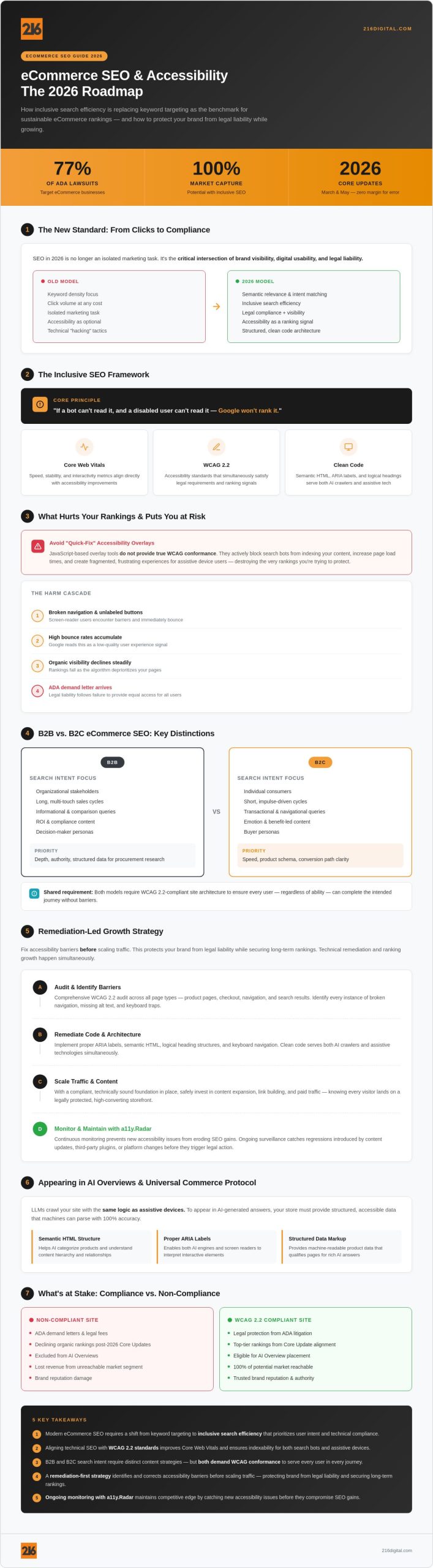
In 2026, search engine optimization (SEO) is no longer an isolated marketing task. It’s the critical intersection of brand visibility, digital usability, and legal liability. Traditional methods that relied on keyword density have been replaced by sophisticated semantic relevance and intent matching. Search engines now prioritize how well a store serves its entire audience, including those using assistive technologies. If your content doesn’t align with the specific intent of a query, no amount of technical “hacking” will secure a top position.
As a business owner, you must adopt the role of the Authoritative Protector. This means your eCommerce search engine optimization strategy isn’t just about chasing traffic; it’s about guarding your brand against the rising tide of ADA demand letters and regulatory penalties. With the release of Google’s March and May 2026 Core Updates, the margin for technical error has vanished. If your site structure is fragmented or your data is poorly organized, you aren’t just losing rankings. You’re inviting litigation by failing to provide an equal experience for all users.
The introduction of AI Overviews and the Universal Commerce Protocol has transformed the click-through landscape. To appear in these AI-generated answers, your store must provide structured, accessible data that machines can parse with 100% accuracy. This evolution demands a shift in how we view “optimization.” It’s no longer about winning a click at any cost; it’s about building a stable, inclusive storefront that regulators and search bots alike recognize as high-quality.
The Shift from Clicks to Compliance
Search engines now treat significant accessibility barriers as a primary indicator of poor user experience. When screen-reader users encounter broken navigation or unlabeled buttons, they bounce immediately. These high bounce rates signal to Google that your site is low-quality, leading to a steady decline in organic visibility. Inclusive SEO is the non-negotiable standard for eCommerce success in 2026, ensuring that your storefront remains reachable and usable for every potential customer.
AI-Driven Search and the Importance of Clean Code
Large Language Models (LLMs) crawl your site with the same logic as assistive devices. They rely on semantic HTML to understand product relationships and hierarchy. Clean code is no longer just a developer’s preference; it’s a dual-purpose requirement for both SEO performance and ADA necessity. By using proper ARIA labels and logical heading structures, you help AI search engines categorize your products while simultaneously meeting WCAG 2.2 conformance standards. When your code is clean, you remove the friction that prevents both AI and human users from completing a purchase.
Building a Foundation: Technical SEO and Accessibility Synergy
Technical health is the bedrock of any successful digital storefront. In 2026, Google’s algorithm treats accessibility as a direct proxy for user experience quality. If a search crawler cannot parse your navigation or a visually impaired shopper cannot interact with your checkout, your store will not achieve its ranking potential. This is the “Inclusive SEO” framework in action. It operates on a simple, high-stakes principle: if a bot can’t read it, and a disabled user can’t read it, Google won’t rank it. Maintaining this foundation also requires consistent uptime; small business owners can use sitesentry-8.polsia.app to monitor their site’s availability and ensure it remains reachable for all visitors. Successful eCommerce search engine optimization now requires a unified approach where technical remediation and ranking growth happen simultaneously.
You must avoid the temptation of “Quick-Fix” accessibility overlays. These JavaScript-based wrappers often block search bots from indexing your actual content while creating a fragmented, frustrating experience for users with assistive devices. These tools don’t provide true WCAG conformance; instead, they often destroy technical SEO performance by increasing page load times and obscuring the clean code search engines crave. A resilient site architecture serves two masters: it optimizes your crawl budget so bots can find every SKU, and it provides logical navigation that guides every human user toward a conversion.
Core Web Vitals and WCAG 2.2 Alignment
The overlap between Core Web Vitals and accessibility is undeniable. Improving Interaction to Next Paint (INP) is a primary SEO goal, yet it also directly benefits keyboard-only users who rely on rapid feedback to navigate. Similarly, visual stability (measured by Cumulative Layout Shift) is a cognitive accessibility requirement. When elements jump on a screen, they cause confusion for users with vestibular disorders and trigger ranking penalties from Google. Aligning these metrics ensures your site is both fast and stable. For those seeking deep-dive protection, our ADA web accessibility compliance services provide the technical oversight needed to bridge these gaps.
Structured Data for Inclusive Search
Structured data acts as a vital bridge between accessibility labels and search engine understanding. By using Schema.org, you provide rich context for products, reviews, and real-time availability that AI-driven search engines use to populate results. This structured approach helps machines interpret the purpose of every element on your page. During a technical audit, implementing a proper aria label strategy is essential. These labels tell both screen readers and search bots exactly what a button or link does, ensuring your site is fully understood by all visitors. Our team can help you identify these critical gaps during a professional technical remediation audit.
Strategic Comparison: B2B vs. B2C eCommerce SEO Models
While the fundamental mechanics of eCommerce search engine optimization remain consistent across industries, the execution diverges sharply when comparing B2B and B2C models. In the B2C sector, you’re targeting the individual consumer whose intent is often transactional and driven by immediate emotional or functional needs. Conversely, B2B models focus on the organizational stakeholder. These users are typically part of a multi-layered decision-making unit where search intent is rooted in technical specifications, long-term compatibility, and risk reduction. Your strategy must adapt to these distinct psychological profiles to capture and convert high-value traffic.
B2B landing pages face significantly higher scrutiny for ADA compliance than their B2C counterparts. This isn’t merely a best practice; it’s a requirement driven by government and corporate procurement rules. Large organizations and public entities often mandate that their vendors meet specific WCAG 2.2 standards before a contract can even be considered. If your B2B portal isn’t accessible, you’re effectively locking your brand out of enterprise-level opportunities. In both models, trust signals such as security certifications, accessibility conformance statements, and verified reviews act as vital differentiators. They reassure the buyer that your storefront is stable, professional, and built for long-term partnership.
The B2B Buying Cycle and Content Strategy
B2B search intent is rarely satisfied by a single visit. It requires mapping content to a complex decision-making process that spans from initial research to final procurement. This is why PPC management for B2B brands must align perfectly with your organic SEO to capture leads at every stage of the funnel while mitigating the risk of fragmented messaging. B2B spec-sheet SEO thrives when technical documentation is delivered through accessible PDF and table formatting, ensuring that complex data is indexable by bots and readable by assistive technologies with equal precision.
CRO for All Users: The B2C Conversion Engine
In the B2C space, the conversion engine relies on removing every possible point of friction. Accessible checkout experiences are a primary tool for reducing cart abandonment, as they ensure that shoppers using screen readers don’t encounter technical roadblocks at the most critical moment. Inclusive design also has a measurable impact on “Time on Page” and “Conversion Rate” metrics, as a more usable site naturally encourages deeper exploration. With mobile commerce expected to account for nearly 60% of all online retail sales in 2026, B2C brands must prioritize mobile-first accessibility to maintain search dominance and capture a share of the projected $1.38 trillion US eCommerce market.
Execution: A Remediation-Led Strategy for Sustainable Growth
Successful execution begins with a fundamental shift in priorities. You must adopt a remediation-led approach to eCommerce search engine optimization. Chasing visibility without first securing your technical foundation is a strategic error. Scaling traffic to a storefront with significant accessibility barriers effectively invites legal scrutiny by increasing the visibility of your compliance gaps. By fixing these barriers first, you create a stable environment where your SEO gains are protected from the sudden impact of regulatory enforcement or manual penalties. Visibility requires stability.
Conducting a dual-purpose audit allows you to identify ranking gaps and compliance failures in a single, efficient process. This methodical oversight ensures that every technical correction serves both a search bot and a human user. When performing keyword research, you should look beyond high-volume terms to capture “Inclusive Intent.” These are queries from users seeking specific accessible features or those using assistive technologies. This targeted strategy builds deep authority in niche segments that competitors often ignore, reinforcing the long-term stability of your eCommerce search engine optimization efforts.
A dual-purpose audit identifies ranking gaps and compliance failures simultaneously. Your remediation checklist should include:
- Checking for missing or non-descriptive ARIA labels on interactive elements.
- Verifying that all navigation menus and checkout buttons are fully keyboard-accessible.
- Analyzing page load speeds across mobile devices and assistive hardware.
- Identifying unlinked or poorly structured product categories that hinder crawl budget.
On-Page Optimization Beyond the Product Description
On-page optimization in 2026 extends far beyond the product description. The strategic use of alt text for images is a prime example; it boosts your visibility in Image Search while ensuring WCAG compliance. Your heading structure (H1-H6) must also be logically ordered. This hierarchy acts as a map for screen readers and search crawlers alike. Descriptive anchor text is equally critical. Instead of generic “click here” links, use keyword-rich phrases that tell the user and the search engine exactly what to expect on the destination page.
Risk-Aware Link Building
Link building in this high-stakes environment requires a risk-aware mindset. Earning backlinks from high-authority, compliant domains signals to Google that your brand is a trusted entity. You must avoid toxic link schemes that offer quick results but lead to devastating manual penalties. Instead, focus on PR and inclusive brand storytelling. When you share how your brand prioritizes accessibility, you earn natural, high-quality links that strengthen your domain authority and protect your long-term growth. If you’re ready to secure your storefront with a strategy that balances growth and protection, explore our Professional SEO and remediation services today.
The 216digital Advantage: Protecting and Growing Your Storefront
Choosing a partner for your digital growth requires more than just finding a marketing agency. In 2026, the stakes are too high for a fragmented strategy. At 216digital, we integrate professional SEO with high-stakes Phase 1 Risk Mitigation to ensure your brand is both visible and protected. We specialize in BigCommerce and Shopify development, providing a unified approach that addresses the technical requirements of search engines and the regulatory expectations of the Department of Justice. Our team acts as your Authoritative Protector, standing between your business and the external threats that often follow rapid organic scaling.
True WCAG 2.2 conformance cannot be achieved through automated shortcuts or temporary overlays. It requires manual remediation by experts who understand the nuances of accessible code and user experience design. We perform deep-domain corrections that fix accessibility barriers at the root, creating a stable foundation for your eCommerce search engine optimization efforts. By aligning your storefront with these rigorous standards, we help you dominate search results while securing the peace of mind that comes from professional excellence and legal stewardship.
a11y.Radar for SEO Stability
Growth often leads to “compliance drift.” As you add new SKUs, update blog content, or modify your site architecture, new accessibility barriers can emerge and compromise your SEO health. Our proprietary platform, a11y.Radar, provides ongoing website accessibility monitoring to prevent these issues from taking root. These recurring technical checks maintain a clean SEO profile, ensuring that your site remains indexable and compliant even as your catalog expands. This continuous oversight is the only way to protect your long-term rankings in an evolving regulatory environment.
Choosing a Strategic Partner for 2026
You need a strategic guide that speaks the language of both Google’s algorithms and modern legal frameworks. A unified approach to design, development, and eCommerce search engine optimization ensures that no part of your digital presence is left vulnerable. When your marketing team and your technical remediation specialists operate as one, you eliminate the friction that slows down growth and creates liability. We invite you to move beyond basic compliance and embrace a strategy that values integrity and thoroughness. Contact 216digital today to protect your business while aggressively growing your reach in the 2026 marketplace.
Securing Your Market Dominance through Inclusive Search
The 2026 digital landscape demands a fundamental shift from aggressive traffic acquisition to a strategy rooted in technical stability and proactive stewardship. You’ve seen how the intersection of technical health and WCAG 2.2 conformance creates a superior user experience that search engines are now hard-wired to reward. By prioritizing a remediation-first approach, you don’t just shield your brand from the persistent threat of ADA litigation; you also ensure that every potential customer can navigate your storefront with ease.
Effective eCommerce search engine optimization is no longer a one-time project but a continuous commitment to professional excellence. Founded in 1999, 216digital brings decades of deep-domain expertise in BigCommerce and Shopify development to your corner. Our proprietary a11y.Radar platform provides the ongoing oversight necessary to maintain your rankings and compliance in an ever-shifting regulatory environment. It’s time to transform your technical requirements into a long-term competitive advantage. Protect your brand and grow your organic traffic with 216digital’s Inclusive SEO services.
We look forward to helping you build a resilient, accessible, and high-performing digital future that stands the test of time.
Frequently Asked Questions
What is the difference between eCommerce SEO and traditional SEO?
eCommerce SEO focuses on optimizing product pages, category hierarchies, and transactional intent, while traditional SEO often targets informational content and brand awareness. In an online store, success depends on managing large volumes of SKUs and complex faceted navigation. This requires a deeper focus on technical site architecture and structured data to ensure search engines can crawl and index every product efficiently without wasting crawl budget.
How does web accessibility affect my eCommerce search rankings?
Web accessibility directly influences your rankings by improving user experience metrics that Google uses as primary quality signals. When your site is accessible, you reduce bounce rates from users on assistive devices and improve Interaction to Next Paint (INP) scores. Google’s 2026 algorithm updates prioritize sites that provide a stable, usable environment for all shoppers, meaning a non-compliant site will likely face a steady decline in organic visibility.
Is WCAG 2.2 compliance mandatory for eCommerce websites in 2026?
Yes, WCAG 2.2 is the recognized legal and technical standard for eCommerce businesses operating in the U.S. and European markets. While the ADA doesn’t explicitly name WCAG in its original text, the Department of Justice and recent court rulings consistently use these guidelines to determine digital accessibility. Failing to meet these standards exposes your brand to significant legal risks and potential exclusion from government or corporate procurement contracts.
Can I use an accessibility overlay to improve my SEO?
No, accessibility overlays typically harm your SEO by adding heavy JavaScript that slows down page load speeds and obscures clean code from search bots. These quick-fix tools don’t provide true WCAG conformance and often create a fragmented experience for screen-reader users. To achieve sustainable eCommerce search engine optimization, you must implement manual remediation that fixes accessibility barriers at the code level rather than hiding them behind a script.
How long does it take to see results from an eCommerce SEO campaign?
Most stores begin to see measurable shifts in organic traffic and keyword rankings within three to six months of implementing a comprehensive strategy. The timeline depends on your current technical health and the competitiveness of your niche. If your campaign begins with a remediation-led approach to fix critical accessibility and indexation gaps, you’ll often see improved crawl efficiency and ranking stability much sooner than through content updates alone.
Does alt text really help with SEO rankings?
Descriptive alt text is a powerful tool that improves your visibility in Image Search while fulfilling a core WCAG requirement. It provides search engines with context about the visual content of your product pages, helping them understand what you sell. When you use keyword-rich alt text, you increase the chances of your products appearing in visual search results, which is a critical traffic driver for eCommerce search engine optimization in 2026.
What are the biggest technical SEO challenges for large eCommerce stores?
Managing crawl budget and preventing duplicate content through faceted navigation represent the most significant technical hurdles for large storefronts. As your catalog grows, search bots can get lost in millions of filter combinations. This leads to poor indexation of key product pages. You must use canonical tags and structured data correctly to guide crawlers toward your most valuable content while ensuring the site architecture remains logically organized for both machines and human users.
How do I balance SEO keyword needs with accessible design?
You can balance these needs by integrating keywords into semantic HTML elements like headings and descriptive anchor text that aid navigation. Accessible design and SEO are naturally aligned; both prioritize clarity and logical structure. Instead of stuffing keywords into hidden areas, use them to create clear, descriptive labels that tell a screen-reader user and a search bot exactly what a page or link contains for the visitor.